
As the Republican Party transitions into a post-Trump era, Utah offers a unique perspective. The state, with its Republican stronghold, last supported a Democrat for president in 1964 with Lyndon B. Johnson. Despite a conservative foundation, Utah has a nuanced relationship with Trump. In 2016, Utah provided him the smallest victory margin of any Republican state, with less than 50% of the vote. While Trump gained more support in subsequent elections, he never surpassed 60% in Utah.
Currently, Utah’s Republican congressional candidates maintain their conservative stance but choose to omit mentioning Trump during campaigns. Chris Karpowitz, a political science professor at Brigham Young University, notes that promoting Trump and his policies may not resonate well with Utah voters as it might in other Republican-dominated states.
“There’s many Republican voters in Utah who have sort of made their peace with Donald Trump enough to vote for him,” Karpowitz explains. “But that doesn’t mean they necessarily support either his style of politics or some of the policies that he pursues.”
Voters in Utah, generally fiscally and socially conservative, often find Trump’s methods, particularly on immigration, unpalatable. His controversial remarks on Islam and other religions further alienated voters in this state known for religious diversity, notably associated with the Church of Jesus Christ of Latter-day Saints.
In 2023, a Deseret News/Hinckley Institute of Politics poll showed only 44% of Utahns approved of Trump’s performance. Support from Utah Republicans decreased by 10 points.
A Safe Republican Seat Without Trump
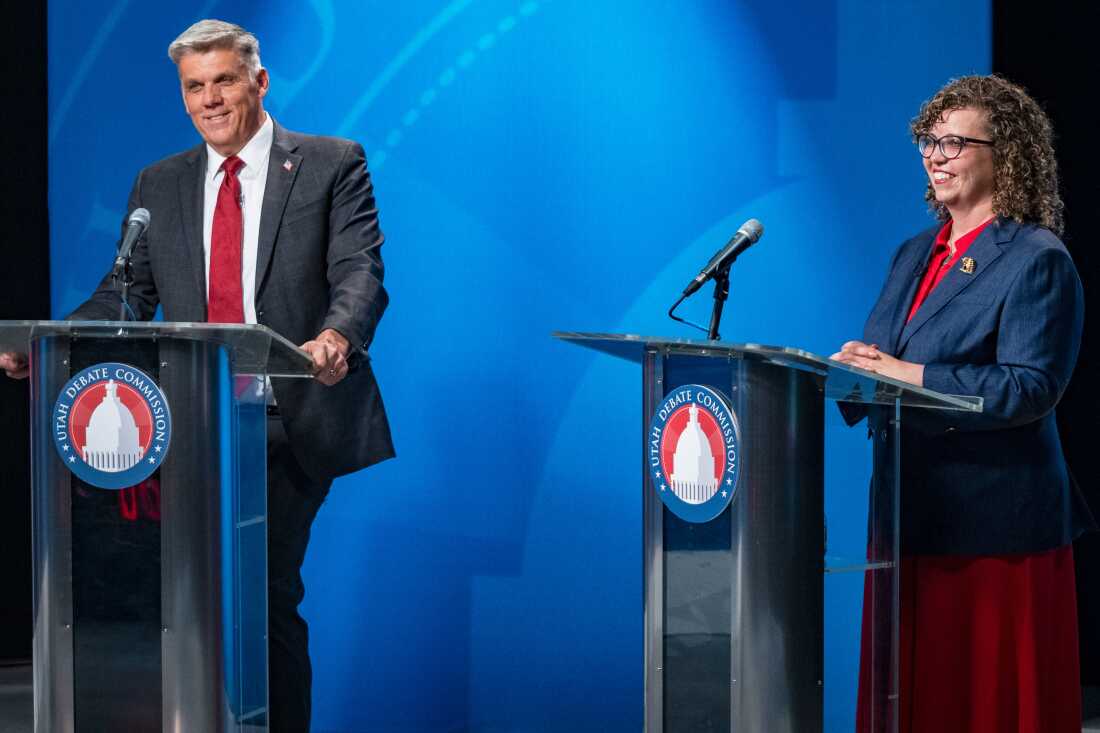
Focusing on the 3rd Congressional District’s Republican primary, both candidates are robust conservatives and support Trump. Yet neither Rep. Celeste Maloy nor Phil Lyman extensively references Trump in their campaigns. They opt for established campaigning tactics, concentrating on local issues, achievements, and opponent critiques.
Maloy epitomizes a policy-driven, mainstream candidate, while Lyman aligns with the America First ideology and the Freedom Caucus. Their primary contest will indicate which Republican style resonates with this newly redistricted area. This district, Utah’s largest, extends from the north to the Arizona border, encompassing rural regions, national parks, Park City, and the blue-leaning suburbs of Salt Lake City. It also includes Brigham Young University in Provo and parts of rapidly expanding southwestern Utah.
According to the Cook Political Report, it ranks among the most Republican districts in the U.S. Maloy, who declined multiple interviews with NPR, has not been warmly received by all Utah Republicans. Despite winning a special election in 2023, she narrowly won the 2024 primary. Although Trump endorsed her for the 2024 election, she claimed victory by a margin exceeding 200 votes.
Lyman aims to exploit the lukewarm reception towards Maloy. Known to Utah voters from his 2024 gubernatorial run, Lyman adopts a new campaign strategy. He received a pardon from Trump in his first term after leading an illegal ATV protest on protected federal land and remained aligned with the MAGA movement during his legislative career. His congressional campaign centers on dismantling the establishment, reducing federal power, and enhancing rural viability and transparency, particularly in elections.
“What is at stake here is are we going to go down a collectivist technocratic, centralized power model, or are we going to retain an American independent individual autonomy,” Lyman expressed to NPR. “I believe in the Constitution. I believe in the government staying in its lanes. I believe that a government closer to the people is better. I don’t like centralized power.”
Lyman views the Freedom Caucus, known for its conservative stance, as a group that adheres to the Constitution, constituents, and freedom, though he explicitly avoids pledging allegiance to the president.
Campaign Outreach
In Utah County, the most populated area, Lyman’s volunteers canvass, but Trump’s name remains absent from their discussions, preferring to emphasize Lyman’s commitment to transparency and accountability.
During a congressional debate, Maloy highlighted her Washington work, including tax cuts outlined in the One Big Beautiful Bill Act, without acknowledging them as “Trump tax cuts.” She underscored participation in the House Appropriations and Natural Resources Committees as vital to her district’s interests.
“I think people in CD3 are going to be looking for someone who can competently represent their issues on a national stage and solve problems,” Maloy told Utah reporters post-debate. “That’s what I love to do. I’m a problem solver by nature. I like policy. That’s what got me into politics.”
In the debate, Maloy endorsed Trump’s intervention in the U.S.-Iran war yet distanced herself from broader associations with Trumpism, appealing instead to capabilities in problem-solving and policy work.
According to Damon Cann, a political science professor at Utah State University, Utah Republicans generally remain distinct from Trump Republicans, running with past endorsement advantages but without visible Trump loyalty. Trump’s endorsement resurfaced through Truth Social, reaffirming support for Maloy and other incumbents, a gesture with varied weight in Utah compared to Texas or Kentucky.
“Republicans in Utah are ambivalent enough about Donald Trump that I don’t think it carries quite the same weight that it might in other states,” Karpowitz concludes.