
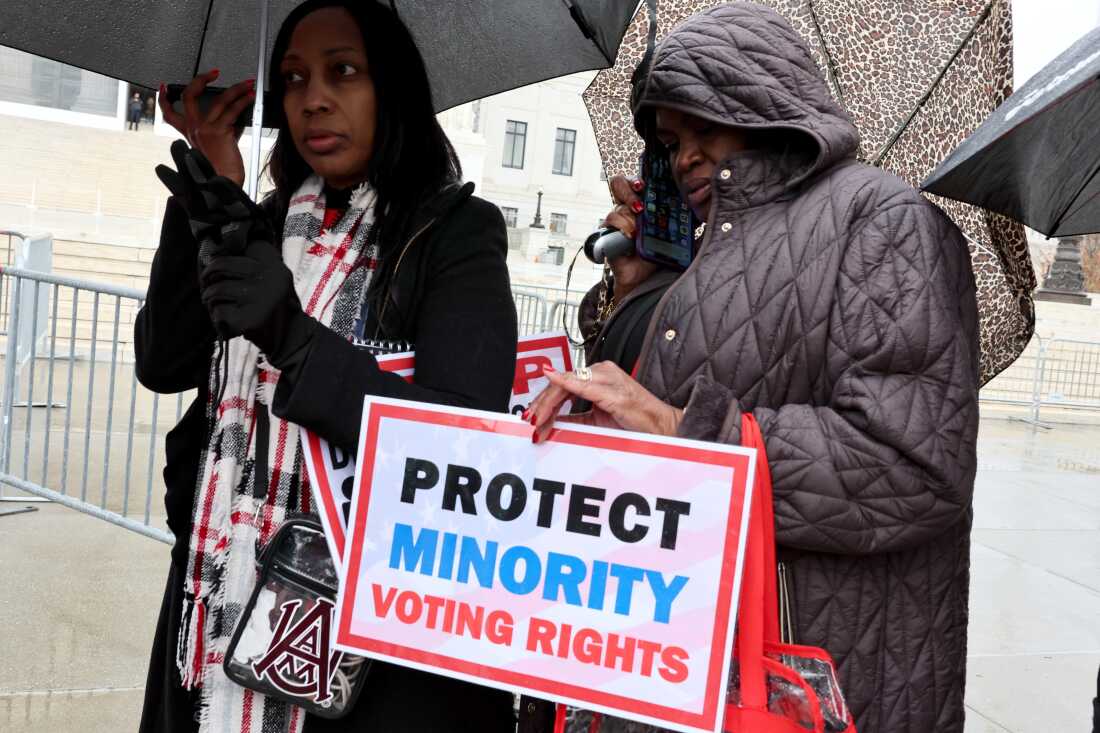
In 2025, demonstrators gathered outside the U.S. Supreme Court in Washington, D.C., holding signs demanding the protection of minority voting rights. Their presence followed the Supreme Court’s decision not to review a significant lower court ruling concerning the Voting Rights Act.
On Monday, the court announced its refusal to hear a lawsuit originating from Arkansas. This decision effectively upholds a 2025 ruling from the appeals panel, which diminishes a long-standing mechanism under the Voting Rights Act for safeguarding minority voters. This ruling impacts seven mostly Midwestern states—Arkansas, Iowa, Minnesota, Missouri, Nebraska, North Dakota, and South Dakota. The decision specifies that private individuals and organizations lack the authority to initiate lawsuits enforcing Section 208 of the Voting Rights Act. Section 208 ordinarily permits voters with disabilities or limited literacy to receive assistance from a person of their choice during voting.
“Our reluctance to take up this ruling further erodes voting rights protections,” stated legal experts observing the case.
The Supreme Court’s decision arrives shortly after the court’s conservative majority issued another ruling that weakened the Voting Rights Act in May. That decision triggered a wave of redistricting across the nation by undermining Section 2 protections against racial discrimination in redistricting.
For years, enforcement of the Voting Rights Act provisions primarily depended on lawsuits filed by private parties. However, in 2021, Justice Neil Gorsuch expressed skepticism about the private right of action in a brief opinion. Since then, Republicans in various states have argued that only the U.S. attorney general possesses the authority to file lawsuits under these act sections.
This interpretation has significant implications, potentially decreasing voting rights lawsuits due to the Justice Department’s limited resources and evolving priorities during different presidential administrations.
The case the Supreme Court chose not to address involved Arkansas United, an immigrant advocacy group. The group assists voters with limited English proficiency by providing Spanish-language interpreters at polling stations. In 2022, a federal judge determined that the Arkansas law restricts helpers to aiding no more than six voters, thereby violating Section 208 of the Voting Rights Act. However, Republican officials appealed, leading to the 8th Circuit panel’s conclusion that private groups like Arkansas United are not authorized to file such lawsuits.
The 8th U.S. Circuit Court of Appeals stands alone in its departure from longstanding legal precedent regarding this issue. The ruling concerning Section 2 likewise reflects this legal divergence.