
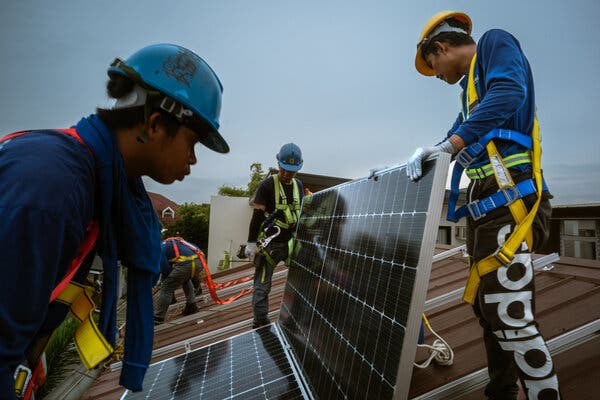
In the wake of increasing energy costs, homeowners and businesses in Southeast Asia, a region heavily dependent on imported oil, are turning to rooftop solar panels. This trend aims to alleviate financial burdens caused by high energy expenses.
Amidst concerns over energy security, individuals are rapidly adopting solar solutions. Heidi Mendoza, residing in Marikina, Philippines, installed solar panels on her home’s roof to ensure uninterrupted power for her online financial literacy classes. Her decision came a few weeks after a conflict in Iran triggered disruptions in energy markets.
Similarly, Ming Kuang Chai, an architect in Kuala Lumpur, Malaysia, opted for solar panels. The ongoing Iran situation and his use of an electric car prompted him to adopt solar energy to manage living costs effectively.
Adiana Julia in Indonesia plans to equip her parents’ house in Yogyakarta with solar panels in the coming year. She emphasizes the importance of reducing dependency on the national grid for energy supply sustainability.
This movement is gaining traction amid geopolitical tensions. The Strait of Hormuz, a crucial passage for oil, remains essentially closed due to the Iran conflict. Despite preliminary agreements between the U.S. and Iran aiming to resolve the war and potentially reopen the strait, the economic repercussions persist.
The Philippine government declared a national emergency following U.S.-Israeli strikes on Iran, cautioning citizens about potential rolling blackouts. The surge in oil prices prompted Mendoza to invest approximately 390,000 Philippine pesos, or $6,500, in solar technology to avoid disruptions in her online work.
China, a leading manufacturer of solar panels, has experienced high demand in Southeast Asia. This year, it exported 5.5 gigawatts of solar capacity to the region, more than double the previous year’s figures. According to Wood Mackenzie, a consulting firm, this capacity can power 1.45 million homes annually.