
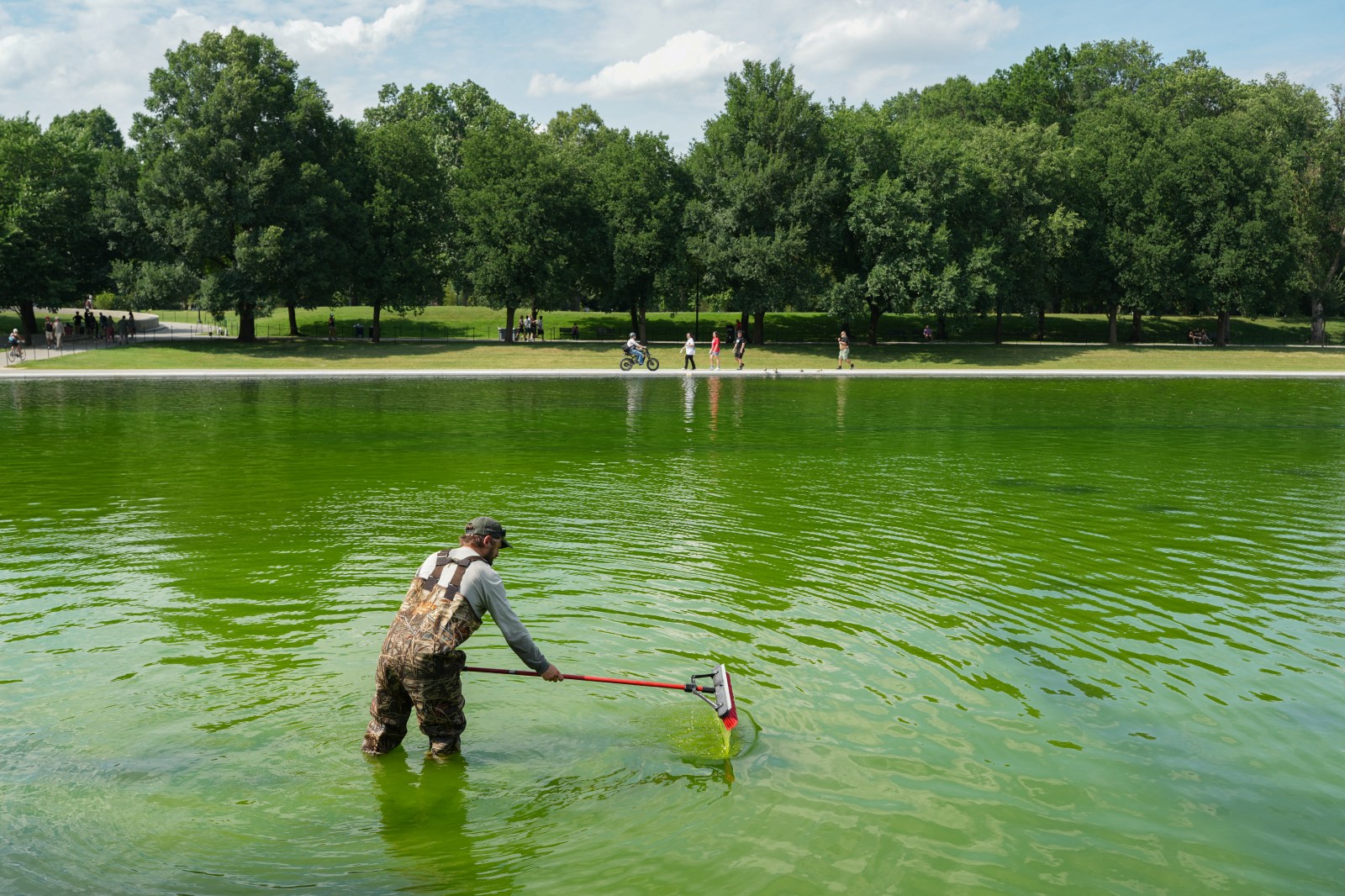
The Lincoln Memorial Reflecting Pool has unexpectedly turned green soon after its reopening. Footage shows workers using hydrogen peroxide to combat a rapidly spreading algal bloom. This cleanup effort follows a costly renovation aimed at achieving a deeper “American flag blue” finish. Questions now arise about what went wrong and the safety of the chemical treatment employed.
Why the Lincoln Memorial Reflecting Pool Turned Green
Algal blooms in the reflecting pool are not unheard of. The shallow, slow-moving water—partly fed by the nearby Tidal Basin—creates favorable conditions for growth. However, the speed of this recent bloom has caught attention.
The pool was drained, repainted, and refilled quickly, possibly leaving behind residual algae in the pipes and systems and introducing warm water during early summer heat. Christopher Lowe, a marine biologist at Swansea University, explained that rapid algae reproduction is nearly unavoidable. He mentioned that algae could re-enter water systems through various means, such as being carried by birds.
For an algal bloom to develop, Lowe noted, it requires sufficient light and nutrients. While sunlight cannot be controlled on an outdoor site like the National Mall, nutrient levels can be managed.
Why Hydrogen Peroxide Is Being Used
Hydrogen peroxide is commonly utilized in water treatment as an oxidizing agent to decompose algae and other organic contaminants. Officials describe it as a “milder treatment than chlorine,” often employed in natural swimming pools and similar environments where wildlife is present.
Alongside hydrogen peroxide, the pool now uses “nanobubble” ozone systems to eliminate algae and pathogens throughout the water. However, treating a pool containing about 6.5 million gallons of water presents significant logistical challenges. Lowe stated that pool maintenance involves controlling natural cycles, and hydrogen peroxide is a common option in such cases. It kills and bleaches the algae, enhancing the pool’s appearance.
Problems With Using Hydrogen Peroxide
The use of hydrogen peroxide to address the algal bloom has sparked questions about both the treatment’s efficacy and its broader implications.
1. The Sheer Scale Problem
The Lincoln Memorial Reflecting Pool holds approximately 6.5 million gallons of water. Skepticism exists regarding the effectiveness of manual dosing. Workers pour 12 percent hydrogen peroxide from the edge, but effectively treating such a large body of water would typically require extensive quantities. Experts emphasize that dosing in open systems should prioritize concentration over volume, adding complexity to large-scale treatment.
2. Cost vs. a Short-Term Fix
While hydrogen peroxide is a widely-used algicide, it is not a lasting solution. According to Lowe, it only works briefly. Because it quickly breaks down into oxygen and water, it does not remain in the system long enough to prevent future growth. This prompts questions about cost-effectiveness. Treating a pool of this size with the necessary concentrations repeatedly could become costly, especially compared with long-term solutions centered on nutrient control and circulation.
3. A Design Trade-Off: Still Water vs. Circulation
The pool’s design presents an ongoing conflict. Algae thrives in the warm, slow-moving water required for the landmark’s mirror-like surface. Increased circulation or aeration can help reduce algae but can also disrupt reflections. This balance between aesthetics and water quality has challenged renovation efforts for decades. The recent renovation, including resurfacing and changes to the basin, may have altered heat and nutrient dynamics, potentially accelerating algae growth.
4. Wildlife and the Wider Environment
The reflecting pool connects with its environment. Birds, debris, and runoff interact with the water daily. While the added chemicals should not harm wildlife or humans due to the ratios used, wildlife still contributes to ongoing algae growth. Lowe noted that even a sterilized pool would see algae quickly return through water inflow or on birds’ legs.
Repeated chemical control poses ecological trade-offs. While hydrogen peroxide is generally considered less harmful than chlorine and breaks down into non-toxic components, continuous dosing could limit plant and other matter survival in the water. Lowe remarked that continued use essentially creates an ecological void where nothing can thrive.