
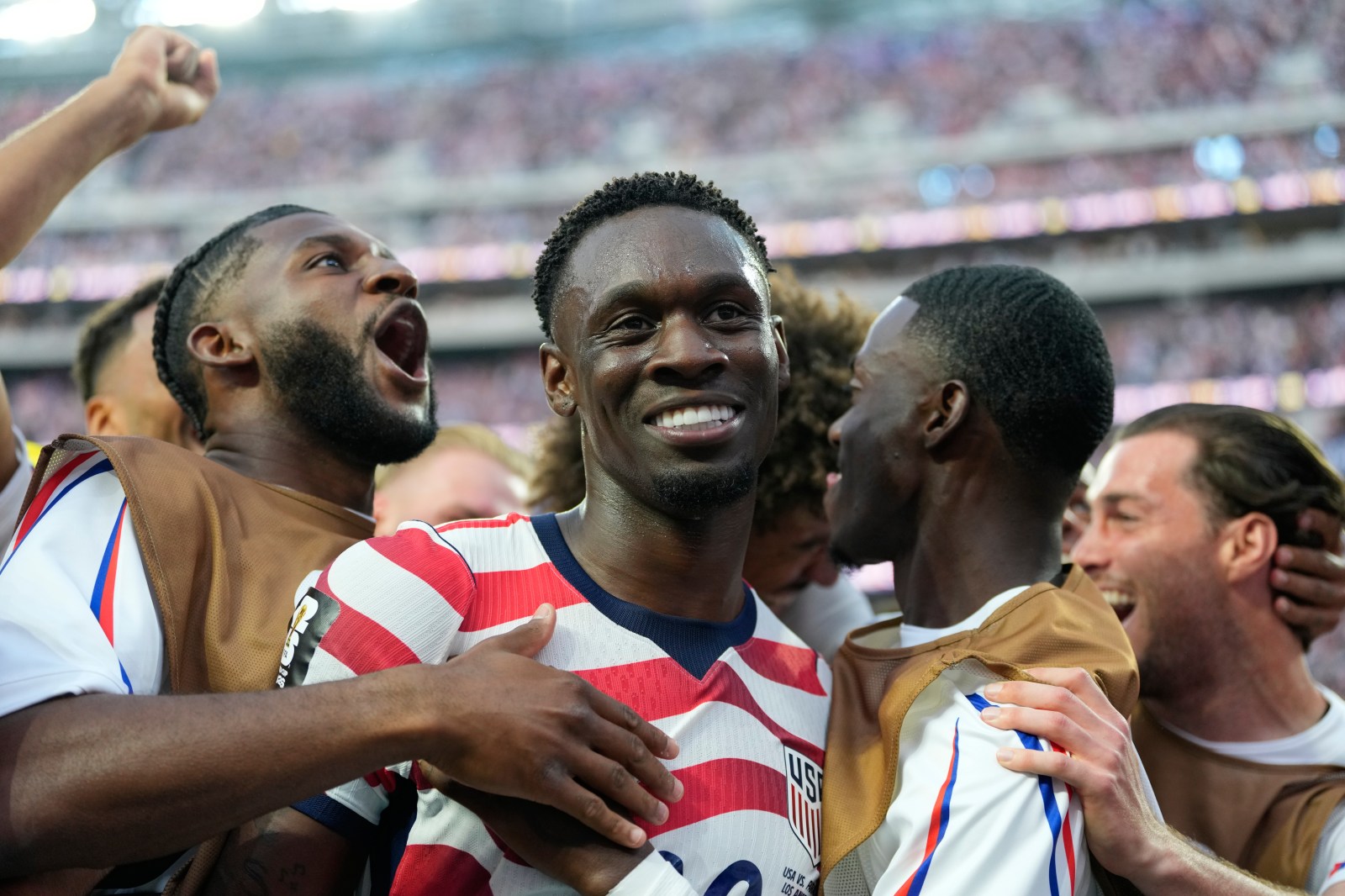
Folarin Balogun has become a significant figure for the U.S. men’s national soccer team (USMNT) after scoring twice in their 4-1 World Cup victory over Paraguay. Balogun, born in Brooklyn, New York, holds U.S. citizenship by birth, a status that former President Donald Trump aims to eliminate in his second term.
Balogun’s remarkable achievement makes him the first U.S. male player to score more than one goal in a World Cup match since the 1930 tournament. While Trump praised the USMNT’s win, he also brought attention to his immigration policies, especially during a World Cup fraught with visa controversies. A Somali referee’s entry was denied, and tensions with Iran affected travel plans for Tehran’s team, who train in Mexico and commute to U.S. matches.
Who Is Folarin Balogun?
At 24, Folarin Balogun stands out as a promising forward. He joined Arsenal’s academy in England at eight and moved to AS Monaco in August 2023. Balogun was born in 2001 during his mother’s temporary stay in the U.S., granting him birthright citizenship under the 14th Amendment. This allows him to represent the USMNT in the World Cup.
After leaving the U.S. as an infant, he grew up in England with Nigerian parents. Eligible for England, Nigeria, and the U.S., Balogun chose the USMNT in 2023 following a training camp in Florida. In July 2023, he shared his commitment on social media, expressing pride in representing the U.S. at such a high level. His recent accomplishments include scoring two goals against Paraguay during his World Cup debut.
The topic of birthright citizenship has sparked discussions among sports fans and immigration experts. Immigration attorney Greg Siskind pointed out that Balogun’s eligibility hinges on his birthright citizenship. Meanwhile, journalist Robert Peston highlighted the irony of Balogun’s accidental birth in Brooklyn, emphasizing how Trump’s policies might have altered his trajectory.
Understanding Birthright Citizenship
In the U.S., birthright citizenship accords citizenship to all children born within its borders, a right established by the 14th Amendment in 1868. Section 1 states: “All persons born or naturalized in the United States, and subject to the jurisdiction thereof, are citizens of the United States and of the State wherein they reside.” The amendment requires no prerequisite for the parents’ citizenship.
Trump’s Stance on Birthright Citizenship
Trump has targeted birthright citizenship from the start of his second term, issuing an executive order to eliminate it. According to his proposal, citizenship would only be granted if at least one parent is a U.S. citizen or lawful permanent resident. This order has faced multiple legal challenges, preventing it from taking effect.
The Supreme Court heard arguments regarding Trump’s 2025 order on birthright citizenship. Discussions revealed skepticism about narrowing this constitutional right, with justices questioning the historical precedents used to justify the changes. Chief Justice Roberts and others, including Neil Gorsuch, Brett Kavanaugh, and Amy Coney Barrett, expressed doubts about the basis for such revisions.
The court’s pending decision could reshape a key constitutional principle linked to immigration and citizenship. Legal experts suggest the outcome might also determine presidential power in altering established laws and protections. Research indicates Trump’s order could impact over 250,000 babies born in the U.S. annually. A verdict from the court is anticipated before its term concludes, likely in late June.
In May, Trump conveyed his discontent on Truth Social, criticizing the court as “rigged,” drawing parallels with what he perceives as a flawed political system. He asserted his election victory as a mandate to continue his political battles.