
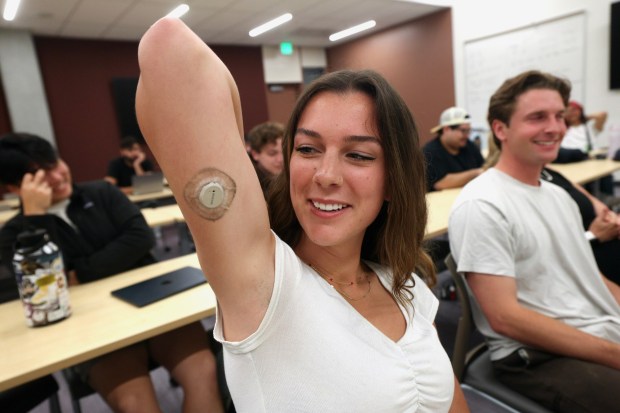
Adam Van Voorhees, a 22-year-old student, frequently ate orange chicken until a noticeable change prompted him to reconsider his diet. A round white patch appeared on his arm, signaling a spike in his blood sugar to prediabetic levels following meals at Panda Express. Though he isn’t diabetic, Van Voorhees now packs his lunch, influenced by data from his continuous glucose monitor (CGM), a device typically used by those with Type 1 diabetes.
The CGM, once prescription-only, became available for health-conscious consumers through Dexcom’s Stelo. Mary Boyle, a cognitive science professor at UC San Diego (UCSD), saw its potential for offering insights into personal health. She involved her students in a class, Metabolic Health Analytics, to study how such monitors might contribute to healthier lifestyle choices.
During a class demonstration, Rylan Breneman, another student, shared her experience with the Dexcom CGM. Boyle’s initiative aims to see if the device’s effectiveness for diabetics can translate to non-diabetics. The data is being collected for a potential clinical study. According to Boyle, while some conclusions are intuitive (e.g., fast food impacts health), students were often surprised by the real-time feedback on their lifestyle choices.
“Panda Express isn’t good for you,” Boyle commented after reviewing the data. “Even a brain affected by Type 2 diabetes can resemble one with Alzheimer’s as glucose absorption issues starve neurons.”
Dr. Robert Thomas, a clinical investigator at UCSD, agreed that factors like diet, sleep, and stress impact both metabolism and brain health. He noted that although these variables are well-studied in diabetics, their effects on healthy individuals warrant new research.
Boyle provided each student with three Stelo monitors to explore personal hypotheses in what’s known as an N-of-1 experiment. Students recorded their glucose levels and shared experiences in class. Jaidy Leyva’s chocolate experiment showed noticeable differences in glucose response depending on the cake’s source, highlighting how individualized such reactions can be.
Boyle’s class emphasizes direct experience over theoretical learning. Despite occasional regressions into old habits, many students reported adopting healthier behaviors after observing their glucose data. Real-time feedback acts as a deterrent, signaling internal inflammation when food choices were less than optimal.
Despite the benefits, not all students found the monitoring stress-free. Rithika Muttukuru mentioned “device burden” due to frequent alarms. Dr. Thomas warned about unnecessary stress from constant monitoring, suggesting occasional checks could suffice, particularly for those at risk of health issues.
Students like Leyva noted the value of real-time feedback over generalized advice. Seeing the immediate impact of lifestyle choices created a personal connection with their health data. This visual evidence provided a stronger impetus for change than advice alone.