
The upcoming World Cup is set to face sweltering conditions, with many games expected to be played in temperatures exceeding 90F (32C). This could make it the hottest edition since the U.S. hosted the tournament in 1994. During that event, over 80% of matches were held before 5pm local time, often leading to challenging conditions under the intense afternoon sun. A notable instance was Mexico’s 2-1 victory over the Republic of Ireland in Orlando, where pitch temperatures reached 117F.
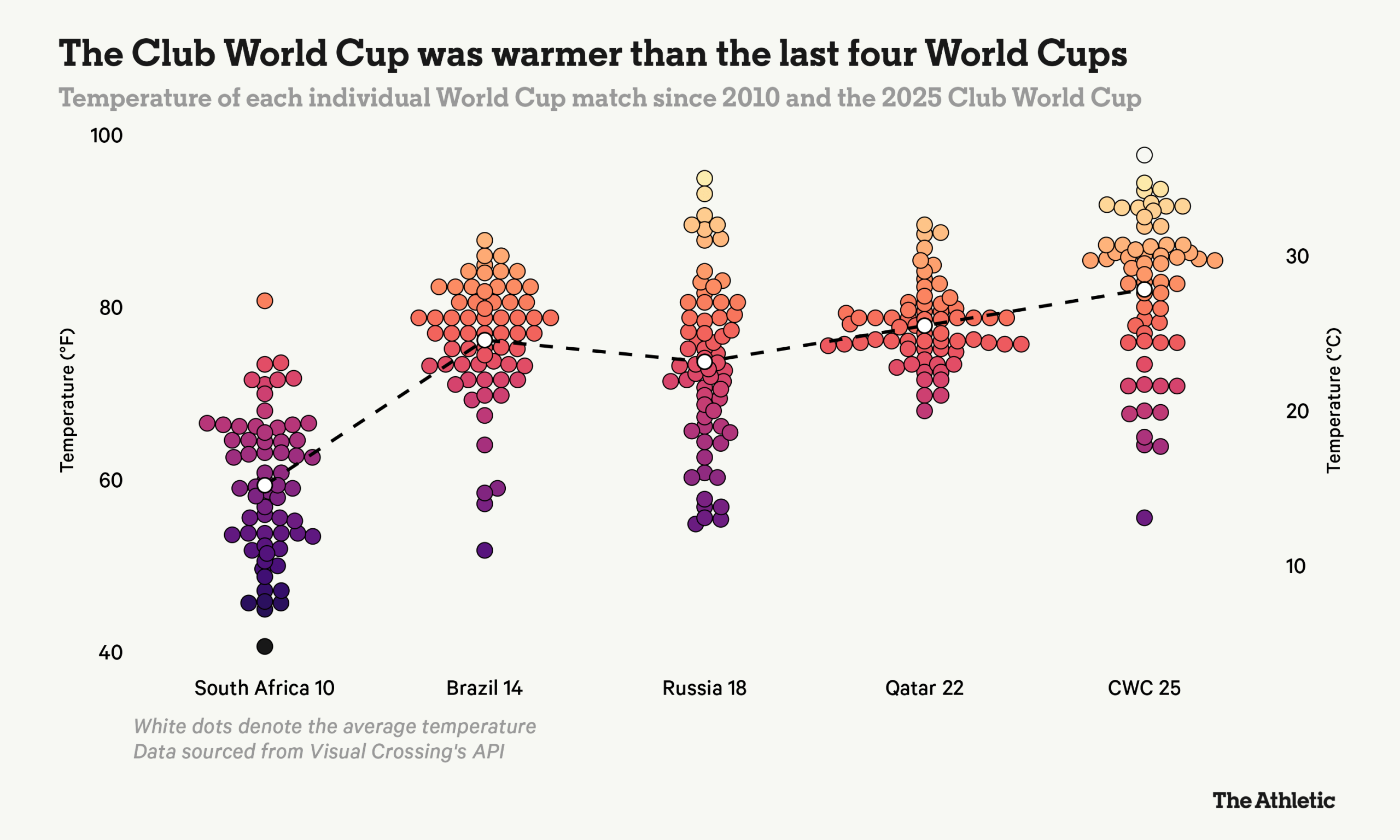
There is little reason to anticipate different conditions for this tournament. Last summer’s FIFA Club World Cup in the U.S. served as a preliminary test, showing higher temperatures than the last four World Cups. Only five of the stadiums used in that competition will host matches in this World Cup, which also spans across Mexico and Canada.
The Athletic gathered 10 years of hourly weather data for each fixture, considering kick-off times and an hour span around the match dates. For example, the Kansas City quarter-final on July 11th at 8pm required analyzing weather data from July 8th to 14th for the past decade. Findings revealed that AT&T Stadium in Dallas might average around 90F (32C), with Monterrey’s Estadio BBVA closely following. Conditions may peak on July 14, with the AT&T Stadium hosting a semi-final at an estimated 93F (34C).
While Dallas, Atlanta, and Houston stadiums will operate with closed roofs and air conditioning, open-air venues won’t be as lenient. Temperatures have exceeded 100F at six of the 16 stadiums at kick-off time over the past decade. Aaron Mentkowski, chief meteorologist for WKBW-TV Buffalo, explains that fields absorb solar heat, intensifying the warmth, especially when breezes fail to disperse it.
Fields are mostly open while the stands are shaded. The field absorbs solar radiation from the sun and radiates that heat back onto the pitch. Stadiums tend to protect the field from the wind. A breeze would carry some of that heat away, but instead, it just stagnates.
Mentkowski serves as The Athletic’s World Cup weather expert, offering live updates throughout the tournament. Extreme heat can hinder performance, complicating the execution of high-energy play styles. Germany forward Jurgen Klinsmann noted the struggle to maintain rhythm under such conditions during their 1-0 win over Bolivia in 1994.
Some teams are taking unique preparatory measures. Norway’s players were seen training in North Carolina, acclimating to the heat by practicing in shorts under temperatures reaching 90F. Their climate acclimation is critical as studies show that a fit individual from cooler regions typically adjusts to warmer environments within a few weeks.
However, challenges extend beyond heat. Thunderstorms could disrupt logistics. U.S. thunderstorm protocols demand match suspension if lightning occurs within eight miles of a stadium, triggering a 30-minute timer that resets with each new strike. Chelsea experienced a 4-hour, 38-minute delay for similar reasons last summer.
Mentkowski highlights high-risk venues, such as Miami and Mexico City, for daily storms and lightning, while Kansas City may face severe weather given the atmosphere’s instability. Boston, Philadelphia, and New York anticipate rising heat and periodic storms during the World Cup.
These weather disruptions can break a team’s momentum, and unpredictable resumptions can test a team’s focus, affecting nutrition and hydration strategies. The capability to adapt to weather conditions could be as crucial to World Cup victory as player skill, teamwork, or tactics.