
Adding more turmoil to Iran’s chaotic World Cup buildup, the national soccer federation announced that FIFA has revoked the ticket allocation for fans at the team’s three group-stage games held in the United States. This decision impacts the entitlement of each federation participating, allowing them to receive and distribute 8% of the stadium capacity for each game, totaling several thousands of tickets per match.
Typically, these ticket allocations are made available for the most loyal fans soon after the tournament draw. However, Iranians have faced challenges due to a travel ban imposed by the U.S. government over the past five months.
As Iran prepares to open its World Cup campaign on June 15 in a match against New Zealand hosted at the 70,000-seat Los Angeles Rams’ stadium in Inglewood, the federation now asserts it cannot provide any tickets to its supporters. This development adds strain to the existing tensions between Iranian soccer, FIFA, and the U.S., which launched military attacks on Iran earlier this year.
FIFA controls all ticketing operations for the World Cup, yet the Iranian soccer federation claims that the U.S. has taken actions hindering the attendance of Iranian supporters. This incident raises concerns about the influence of non-sporting and political factors on the organization of football’s largest event.
FIFA stated that it is working with the Iran Football Federation to find solutions to maximize the chances for Iranian supporters to attend matches. Meetings have been held between FIFA President Gianni Infantino, CEO Mattias Grafström, and Iranian soccer officials in Turkey to provide logistic support.
Iran’s team has faced disruption, having not competed since February due to domestic league closures caused by the war. They are training in Tijuana instead of a planned location in Tucson, Arizona.
Additionally, some Iranian federation officials have been denied U.S. visas. The Iranian team, however, will be able to enter the U.S. just before their match, with Andrew Giuliani ensuring that those directly associated with entities like the Islamic Revolutionary Guard Corps are restricted.
“The president wants to ensure a level playing field while keeping individuals connected to the IRGC out of the U.S.,” stated Giuliani.
Fans wishing to follow the team face obstacles obtaining visas and making payments amidst financial sanctions. Under current circumstances, the federation is unable to offer tickets as the allocation has been withdrawn.
Though unclear how many tickets were sold or if they were purchased by individuals in Iran or its diaspora—many in the U.S. where a large Iranian community resides—FIFA would need to sell remaining tickets swiftly. FIFA’s sales site lists rows of field-level seats available at $450 each.
Infantino previously emphasized that access to the tournament must be ensured for fans and officials of any qualifying team to host a World Cup successfully.
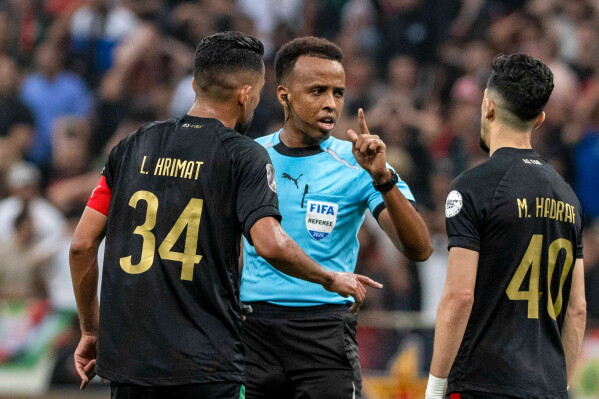
Hostile receptions are becoming a theme as U.S. immigration policies impact World Cup visitors. A FIFA referee from Somalia faced entry denial in Miami. Similarly, an Iraq player was detained, and a photographer was refused entry.
These disruptions prompt questions about the World Cup’s management, contrasting FIFA with possible influence from U.S. government policies.
Piara Powar, of FIFA’s anti-discrimination partner Fare Network, expressed concern that these issues might overshadow the World Cup’s intended celebration of global unity.
Associated Press: Seung Min Kim contributed to this report.