
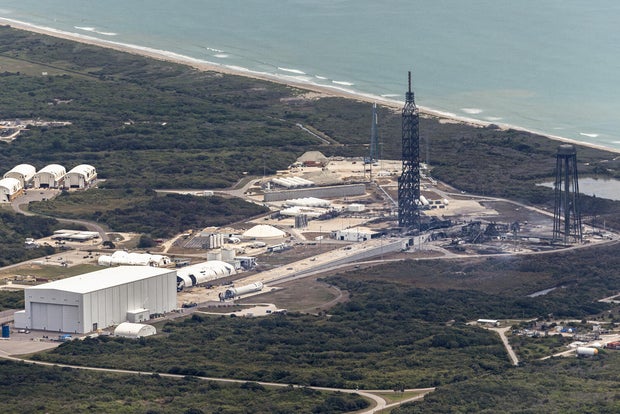
Following an explosion on the launch pad last week, Blue Origin, owned by Jeff Bezos, reported that the damage was less severe than anticipated. The company aims to resume New Glenn rocket launches by year-end.
Blue Origin CEO Dave Limp shared an update on social media platform X. He noted that propellant tanks at Cape Canaveral Space Force Station’s launch pad 36 survived largely intact, as did a nearby hangar. Though the main gantry was damaged, repairs are feasible on-site.
“Now that we’ve accessed the pad and integration facility, there’s some positive news,” Limp stated. “The propellant farm’s tanks, including those for oxygen, liquid hydrogen, and cryogenic methane, remain in good shape. This is fortunate as these components have significant lead times.”
The New Glenn rocket, destroyed on pad 36, included a transporter-erector, essential for moving and positioning the rocket. However, with an alternative system under development, a new transporter-erector isn’t required.
No official explanation for the explosion has been disclosed, but Limp expressed confidence the next launch will occur before year’s end. Blue Origin’s motto, “Gradatim Ferociter,” means “step by step, ferociously.”
The New Glenn was set for a third launch to deliver Amazon Leo internet satellites. Last week, engineers conducted standard tests with supercooled fuels to ensure readiness. The Leo satellites were not affected.
However, as the engines ignited, a fire erupted, leading to the explosion. The impact was felt across the Florida peninsula.
Comparisons to SpaceX
This incident is the first such mishap at a launch pad since a SpaceX Falcon 9 explosion. Blue Origin currently relies on the single pad 36, although plans for additional pads in Florida and California were underway.
The repair of pad 36 is crucial for NASA’s Artemis moon program, which targets beating China in lunar exploration. NASA counts on both SpaceX and Blue Origin to launch lunar landers for tests with Artemis astronauts.
If trial flights succeed, NASA plans for moon landings starting in 2028, with a potential lunar base enabling extended astronaut missions.
Leadership and Future Plans
Nasa Administrator Jared Isaacman remains hopeful about the planned moon landings, emphasizing the quick response by Blue Origin. Director Brian Hughes of Kennedy Space Center reinforced NASA’s focus on achieving the President’s goal of a moon landing by 2028.
Limp’s reassurance of flights resuming might indicate the explosion wasn’t caused by a significant engine issue. This development is relevant for United Launch Alliance, relying on Blue Origin’s BE-4 engines for its rockets. So far, the engines aren’t linked to the mishap.