
Andrew and Casey Kowitz met during their first biology class at Trinity Christian College about a decade ago. She inquired if the seat beside him was occupied, leading them to become lab partners and eventually life partners. A year and a half later, Andrew organized a romantic scavenger hunt across the Palos Heights campus, culminating in a marriage proposal at the spot where they first sat together in class. “I said yes immediately,” Casey recalled. Now, they celebrate over six years of marriage and have two young children. This touching story, intertwined with their memories at Trinity, faces an unexpected twist as the college has announced its closure.
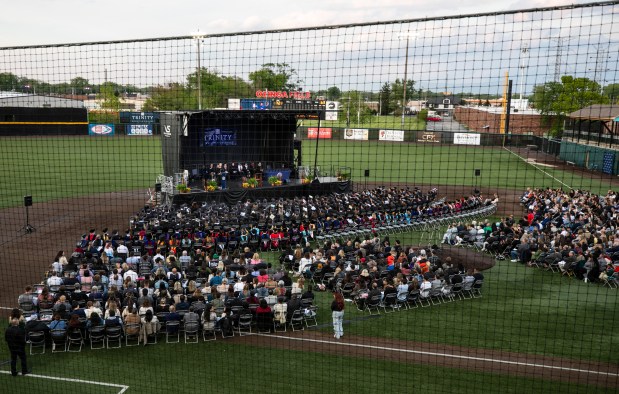
The Trinity board of trustees shared this decision in November, citing declining enrollment and financial issues as the primary reasons. Jeanine Mozie, acting president of Trinity, expressed in a video, “The board has considered every option, but there is no sustainable path for the institution.” The final commencement ceremony occurred on May 8.
This news affected students, families, and alumni deeply. The closure forces families to replan their educational paths and stirs emotional responses from alumni like the Kowitzes. Casey reflected on how significant Trinity was in shaping their lives, saying, “Our family wouldn’t exist without it. Trinity means a lot to us and always will.”
Trinity Christian College is not alone in its struggles. Other Christian colleges are closing, merging, or halting admissions due to similar financial pressures. In 2024, Lincoln Christian University ended operations, and Trinity International University sold its campus to transition to online undergraduate programs. The Chicago Theological Seminary also halted new admissions amid financial difficulties.
Statistics from The Hechinger Report show that roughly 40 Christian colleges have closed or merged since 2020, making up over half of all non-profit college closures nationwide. Challenges such as declining enrollment, financial constraints, and demographic shifts are common across all higher education institutions. The COVID-19 pandemic further impacted these schools, forcing abrupt transitions to virtual classes.
Perry Glanzer from Baylor University commented, “The struggles are universal. As student numbers decline, the situation becomes tougher for institutions of all sizes.” Smaller private colleges, both secular and religious, are particularly vulnerable due to limited resources.
However, some Christian institutions thrive amid these challenges. Enrollment in Catholic and Protestant colleges grew by 1.6% from fall 2023 to fall 2024. Institutions offering online programs expanded significantly, particularly attracting students interested in divinity studies who prefer to stay connected to their communities rather than relocate.
The closing of Trinity Christian College highlights the multifaceted issues facing all higher education sectors. These institutions are navigating decreasing high school graduates and transitioning public perceptions about the value of higher education. A Pew Research Center survey indicated 70% of Americans think higher education is on the wrong track, a sentiment that presents an obstacle to institutions like Trinity as they strive for long-term viability.
Recent Trinity graduate Kylla Hutcherson envisioned her children attending her alma mater someday. She valued the personal connections with professors and the college’s spiritual community. Reflecting on these moments, she emphasized the significance of holding on to such memories, even as the physical spaces themselves disappear.
As higher education grapples with these challenges, Trinity Christian College serves as a poignant example of both the personal impacts of institutional closure and the broader changes occurring across the sector.