
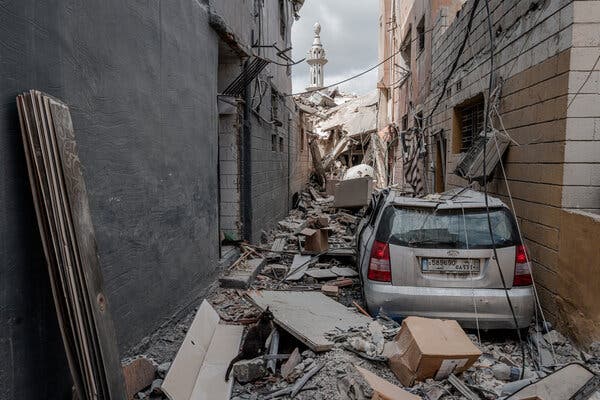
Prime Minister Benjamin Netanyahu announced that Israeli ground forces have moved beyond the Litani River in Lebanon. This development comes as both Israeli and Hezbollah forces engage in frequent skirmishes, undermining a cease-fire established a month ago.
During a visit near the Lebanese border, Netanyahu stated that Israeli forces had “crossed the Litani,” a significant boundary in historical cease-fire agreements. The Israeli military continued issuing evacuation notices to southern Lebanese towns amid ongoing airstrikes in the area. According to Lebanon’s health ministry, over 3,300 people have died since the renewed conflict with Hezbollah began in March.
The military actions coincide with scheduled U.S.-facilitated talks between Israeli and Lebanese military officials at the Pentagon. These discussions aim to stabilize the border and halt the violence. Further political negotiations are set for the following week. Crossing the Litani marks a strategic shift, indicating increased Israeli military operations beyond what Israel terms its “forward defense line,” located miles within Lebanon since the March invasion.
The Litani River generally flows 15 to 20 miles north of Israel but veers closer to the border in the east, where recent clashes have occurred. This isn’t the first time Israeli forces have crossed the river during the current conflict with Hezbollah.
Under pressure from Israeli hard-liners, Netanyahu has escalated military efforts against Hezbollah, including a recent strike near Beirut. Despite these measures, Hezbollah’s drone attacks in southern Lebanon persist. The Israeli government faces pressure to restore security in northern Israel, which has been subject to Hezbollah’s rocket fire.
Discussion at the Pentagon is expected to center on Hezbollah’s disarmament, a crucial demand from Israel. Lebanese President Joseph Aoun, after speaking with U.S. Secretary of State Marco Rubio, emphasized that a cease-fire is essential for further progress.
The Israeli offensive in Lebanon unfolds as Washington and Tehran engage in sensitive negotiations to conclude the broader conflict. Iran has insisted that any agreement must stop Israeli strikes on Hezbollah, spotlighting Lebanon as a critical area in achieving peace.
Supporting this stance, Israel’s military leader, Lt. Gen. Eyal Zamir, confirmed that forces are “moving into new areas” and will continue to target Hezbollah wherever possible.
Reporting contributions from Johnatan Reiss. Euan Ward, a Times reporter based in Beirut, covers events in Lebanon and Syria.