
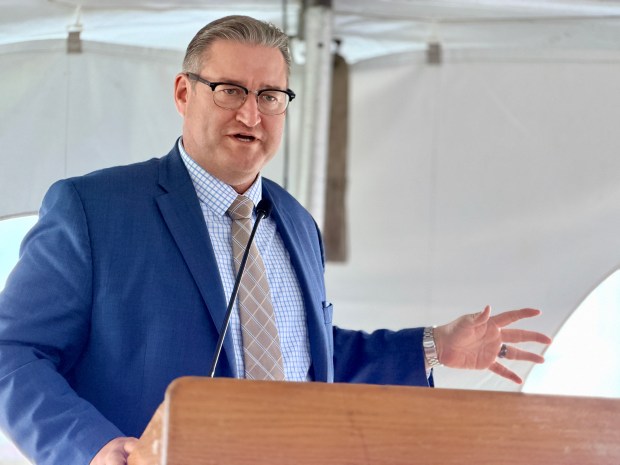
On his second day at the Northern Indiana Commuter Transportation District (NICTD), Mike Noland participated in a public meeting in Munster focused on extending the South Shore Line. This marked the start of the environmental process for the West Lake Corridor. Held at Munster’s Center for Visual and Performing Arts on October 28, 2014, the meeting featured poster boards showing potential routes for the expansion.
The Regional Development Authority’s (RDA) new 20-year strategic plan proposes further expansions, potentially reaching Crown Point, Merrillville, and Valparaiso.
Even in retirement, Noland remains involved in completing the Monon Corridor project, which began full service on April 1. His successor, David Dech, acknowledges Noland’s deep understanding of commuter rail, gained from his time at Metra Electric.
Noland started at Metra in 1983, as the agency was forming in response to private railroads abandoning passenger services. He recalls the financial challenges faced at that time, similar to recent funding issues for public transit in Chicago and Indiana.
Noland began his career in HR, attended law school at night, and advanced to Chief HR Officer by age 30. Later, he was appointed general counsel. After his time at Metra, where he served under troubled CEO Phil Pagano, Noland worked at Iowa Pacific, a short line railway, gaining valuable experience that later helped at NICTD.
Under Noland, NICTD operated much like a short line, efficiently managing resources with limited staff. Noland appointed experienced professionals, like Metra retiree George Hardwich, to evaluate and improve operations. This hands-on approach led to identifying opportunities for schedule improvements and operational efficiencies.
On-time performance is a key metric, along with rider satisfaction,Noland emphasized.
Hardwich’s recommendations included eliminating speed restrictions and optimizing timetables. Infrastructure improvements, such as the Double Track NWI project, significantly reduced travel time by allowing trains to pass more efficiently.
The Monon Corridor project required the relocation of the Hammond Gateway Station to straighten railway curves, with local support aiding in property acquisitions. Collaborative efforts with Metra improved operations for both lines, addressing obsolete speed restrictions.
Noland noted ongoing improvements with Metra, resulting in faster schedules. Engineers used GoPro cameras to test new speed limits safely, successfully reducing travel times.
NICTD’s future plans include relocating the South Bend station, which could yield further significant travel time reductions. Dech confirms local funding is secured, with federal support anticipated due to the benefits created by eliminating several at-grade crossings.
Noland remains optimistic about discovering further efficiencies, reflecting on his career and accomplishments, stating, “We’ve accomplished a lot of them, but there’s still more out there.”
Doug Ross contributed this report as a freelance journalist for the Post-Tribune.