
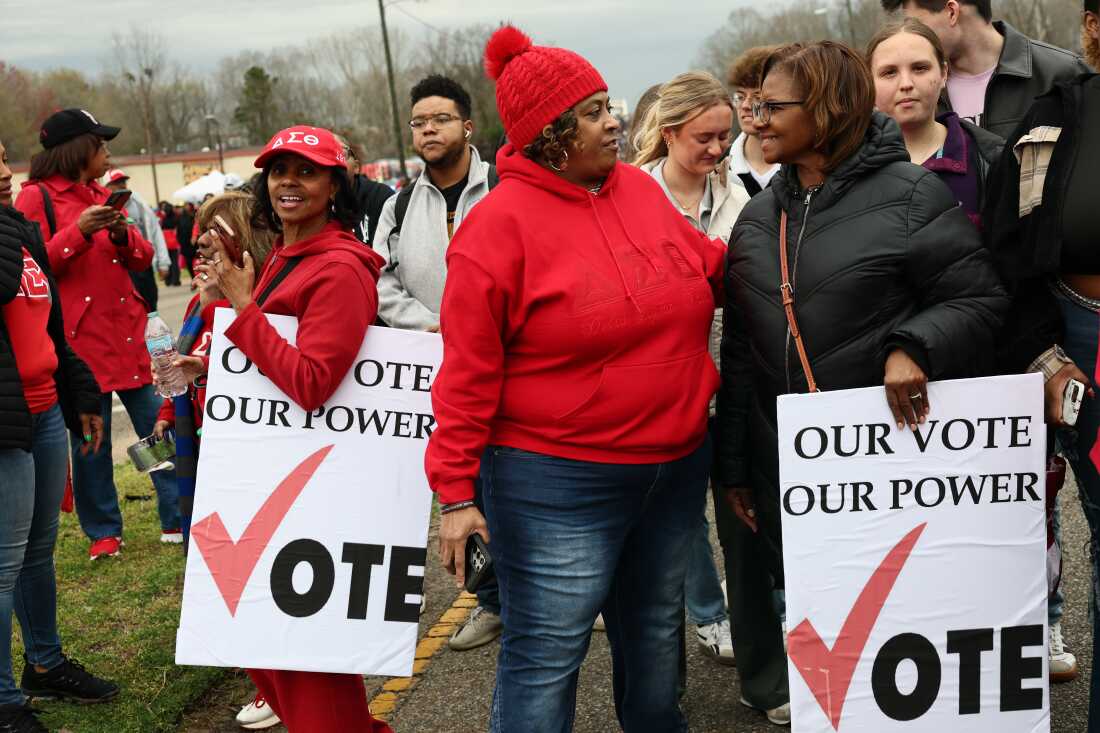
Members of Delta Sigma Theta sorority and other demonstrators assembled in Selma, Alabama, in 2025 to honor the 60th anniversary of the Bloody Sunday march, which was instrumental in the Voting Rights Act’s passage. This historic moment serves as a backdrop for a significant shift in how voting rights are approached following recent changes by the U.S. Supreme Court.
Republican-led Southern states are rapidly altering their congressional maps after the Supreme Court’s decision weakened Voting Rights Act protections against racial discrimination. The most noticeable impact of this ruling is likely on the local level. Legal disputes are ongoing for at least 17 voting maps or election systems for state and local governments in light of the court’s decision, according to an analysis of federal court records by NPR.
Since the Supreme Court released its pivotal decision in Louisiana v. Callais, attorneys involved have been focused on drafting briefs to interpret the ruling’s implications on Section 2 provisions concerning redistricting. The conservative majority of the court has shifted the focus of Section 2 to intentional racial discrimination, which is notoriously difficult to prove legally. Experts are worried this change threatens minority representation and could promote partisan gerrymandering across various government levels, including state legislatures, county commissions, and school districts.
One legal battle over state legislative districts has already ended. Last week, North Carolina state Rep. Rodney Pierce, a Democrat, agreed to drop the lawsuit he and another Black voter initiated in 2023 against the state’s Senate map. Pierce stated, “The Supreme Court’s ruling has made the Voting Rights Act ineffective.” He expressed disappointment at the lack of avenues to protect Black voters’ rights in his region.
Most of the state and local legal contests influenced by the ruling originate from the South, where racial polarization in voting persists. However, similar disputes exist nationwide, such as Latino voters challenging Washington’s legislative map and a Pennsylvania school district’s election system. Native American voters are contesting North Dakota’s legislative map. All these cases now face a heightened legal threshold to argue for voter representation for racial minorities.
How New Limits Complicate Redistricting
Michael Li, a redistricting expert from the Brennan Center for Justice, highlights that Section 2 frequently helped design districts where minority voters could realistically elect candidates of choice. Historically, most federal court rulings altering redistricting maps based on Section 2 involved local governments, mainly in Southern states.
Li notes, “Section 2 broke down political strongholds in the South across partisan and nonpartisan elections. Now, there’s a risk of reasserting white majority rule.” He explains the Supreme Court’s decision encourages arguments promoting political agendas in district design, even where nonpartisan positions are concerned.
Implications of More At-Large Voting Systems
Another challenge is separating race from partisan preference in proving racial polarization, as local partisan election data often don’t exist. Gilda Daniels, a law professor at the University of Baltimore, described this as complex, noting that the Justice Department’s focus has shifted under the Trump administration, as they’ve dropped multiple cases enforcing minority voting rights.
Recent DOJ priorities and the Supreme Court’s ruling may allow local jurisdictions to revert to at-large systems, compromising minority representation. Maureen Edobor from Washington and Lee University explained, “At-large systems favor majority populations, weakening minority votes.
Anticipating More Redistricting Conflicts
Elton Holmes, president of Fayette County’s NAACP branch, anticipates potential setbacks. Despite successfully contesting a voting map in Tennessee last year, Holmes worries about future gerrymandering challenges.
Fair Fight Action and Black Voters Matter Fund estimate that Supreme Court rulings might risk nearly 200 Democratic-held state legislative seats, primarily in majority-Black Southern districts. The high court may continue influencing redistricting depending on future decisions involving the Voting Rights Act.
Edited by Benjamin Swasey