
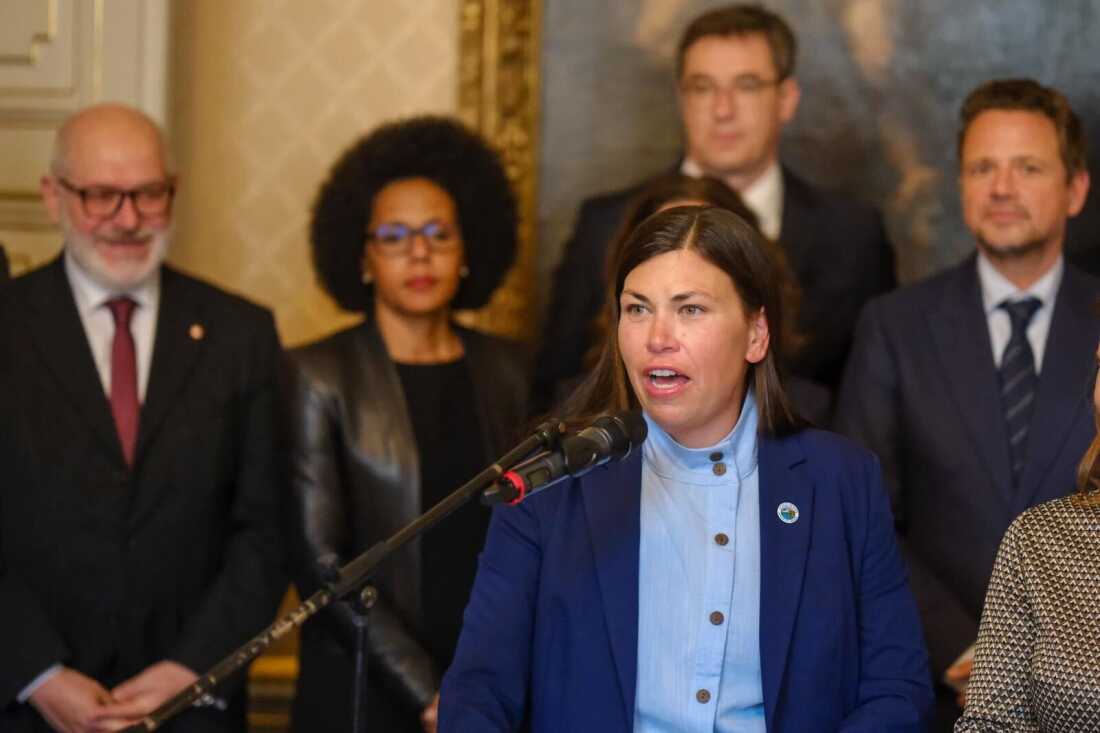
Lacey Beaty, the mayor of Beaverton, Oregon, was among several U.S. city leaders participating in the Pact of Free Cities meeting in Bratislava, Slovakia. This gathering included notable figures such as Omar Al-Rawi from the Vienna City Council, Audrey Pulvar, deputy mayor of Paris, Gergely Karácsony, the mayor of Budapest, and Rafał Trzaskowski, mayor of Warsaw. These representatives came together to discuss strategies for defending democratic values.
For years, right-wing populists in the U.S. have been building political connections across the Atlantic, fostering mutual support and learning. Former President Trump, known for his relationship with ex-Hungarian Prime Minister Viktor Orbán, exemplifies this trend. In response, ten U.S. mayors from liberal cities have united under the Pact of Free Cities to exchange ideas with European counterparts on preserving democracy and combating authoritarianism.
The American cities involved, including Boston, Chicago, San Antonio, and Cincinnati, participated in the recent meeting in person or virtually. Cincinnati Mayor Aftab Pureval expressed his reasons for joining, citing concerns over the Trump administration’s impact on democratic institutions and international relations, particularly with European allies.
The mayors of Bratislava, Budapest, Prague, and Warsaw originally founded the Pact of Free Cities in 2019. Their goal was to uphold progressive values and develop strategies to confront challenging national governments. At the meeting, Budapest’s Mayor Karácsony shared experiences from Hungary, where voters ousted Orbán, a leader whose approach influenced similar tactics in the U.S. Karácsony described how efforts to ban the Budapest Pride parade backfired, leading to a strong public demonstration for free speech and assembly.
This move exposed Orbán’s vulnerabilities and contributed to his electoral defeat.
Lacey Beaty, returning from the meeting, highlighted the collaborative nature of the discussions. She noted that U.S. cities face challenges similar to those in Europe, such as federal funding cuts linked to political disagreements. Beaty mentioned that the Trump administration’s funding restrictions affected Beaverton’s commitment to diversity and inclusion policies.
In Budapest, similar pressures were illustrated by Karácsony’s initiative to use trash trucks for public messaging. Signs on these vehicles held the government accountable for potential service disruptions. Such actions underscore the importance of clear communication from city officials when federal policies threaten local services.
The White House responded to the mayors joining the Pact with skepticism, suggesting prioritizing local safety issues over international networking. Meanwhile, building international ties isn’t unique to progressive efforts. The Conservative Political Action Conference (CPAC) has long fostered relationships with right-wing European populists.
Matt Schlapp, CPAC Chairman, noted that learning from figures like Nigel Farage, leader of Reform U.K., offers insights into mainstreaming controversial topics like immigration. Such exchanges have shaped right-wing dialogues internationally.
Schlapp questioned the potential benefits of the Pact of Free Cities, given distinct challenges faced by U.S. cities. However, he acknowledged that grassroots support efforts, inspired by European activism, might benefit U.S. mayors.