
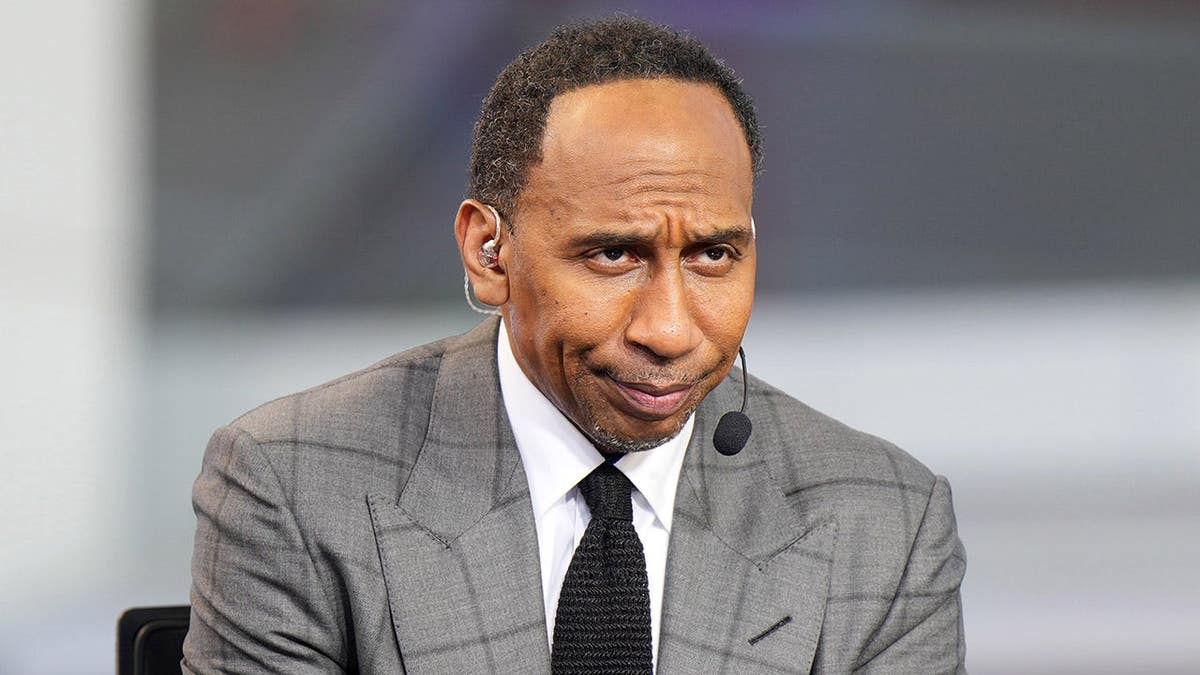
Stephen A. Smith continues to stir controversy with his comments on White basketball players, daring his employers to respond. In July, Smith questioned whether the Los Angeles Lakers could win a championship led by Luka Doncic, Austin Reaves, and Walker Kessler. His reasoning was simple: no team led by three White players had done it before.
Initially, the comment seemed casual. However, Smith kept reiterating it. Recently, he announced that such a team has never won and predicted it ‘won’t happen.’ He went further, urging Black NBA players to prevent it from happening.
On his radio show, Smith asked, ‘You can’t ask LeBron James to overcome [this White trio], but you can ask him, KD, Steph Curry, Ant-Man, Shai, and Wemby, to say, the best team in the NBA right now is being led by three White boys. Are you going to let that happen? Or will you remind them who you are?’
Smith defended his stance to ESPN colleague Jay Williams, expressing a desire to see Black players ensure they do not yield to the ‘White Lakers.’ This shift from citing history to calling for players to uphold it is notable.
Previously, I discussed figures like Kendrick Perkins and Gilbert Arenas, who speak about basketball as if it belongs predominantly to Black people. Smith shares this view. He recently asked Black players, ‘Are you going to hand the NBA to them?’
His statements are unambiguously racially charged. He and others expect no repercussions, assuming society tolerates racism if the perpetrators are Black and targets are White. However, this need not be the case.
ESPN, where Smith is an employee, holds the power to reject such a standard. The network compensates Smith over $20 million annually, yet remains responsible for managing his commentary. How would ESPN react if a White host encouraged White golfers or hockey players to keep Black players from achieving equal status?
Consider the potential fallout if Scott Van Pelt suggested avoiding Black quarterbacks or general managers because a team with such leadership has never won a Super Bowl. If he called on Josh Allen and Joe Burrow to prevent this change, his removal would likely be immediate. Racial sensitivity training would probably follow.
The call here is not for ESPN to terminate Smith, but to challenge his employers to address his behavior. The reasons are apparent beyond the evident double standard. Smith’s basketball analysis lacks grounding. The Lakers’ trio ranks as the NBA’s strongest this season. Their championship odds, positioned at 11th-best, owe more to perceived weaknesses in their all-Black supporting cast.
Even within his racial framework, Smith criticizes the wrong players. Moreover, audience consideration matters. Fans do not typically turn to sports discussion channels, especially during football season, to hear hosts belittling White basketball players. It’s not engaging television.
So, why does Smith persist? He senses an opportunity to evade criticism. Mocking White players appears a tactic to regain favor with what he terms the ‘Black Community’ when under fire. His recent focus follows backlash from that community post his interview with President Trump.
Smith is prioritizing his own interests; ESPN is allowing it. ESPN executives, including Jimmy Pitaro and Burke Magnus, bear responsibility for this environment. They allowed a culture where apparent anti-White racism doesn’t breach company policies; they hesitate to stop it.
This reflects corporate timidity, greatly benefitting Smith. Despite a $100 million contract, his commentary remains rooted in race. A commentator of his stature and pay should meet higher expectations, yet he does not.
Ultimately, Stephen A. Smith didn’t secure his position through merit alone. ESPN, through inaction, is paying the price as his commentary on White basketball players persists.