
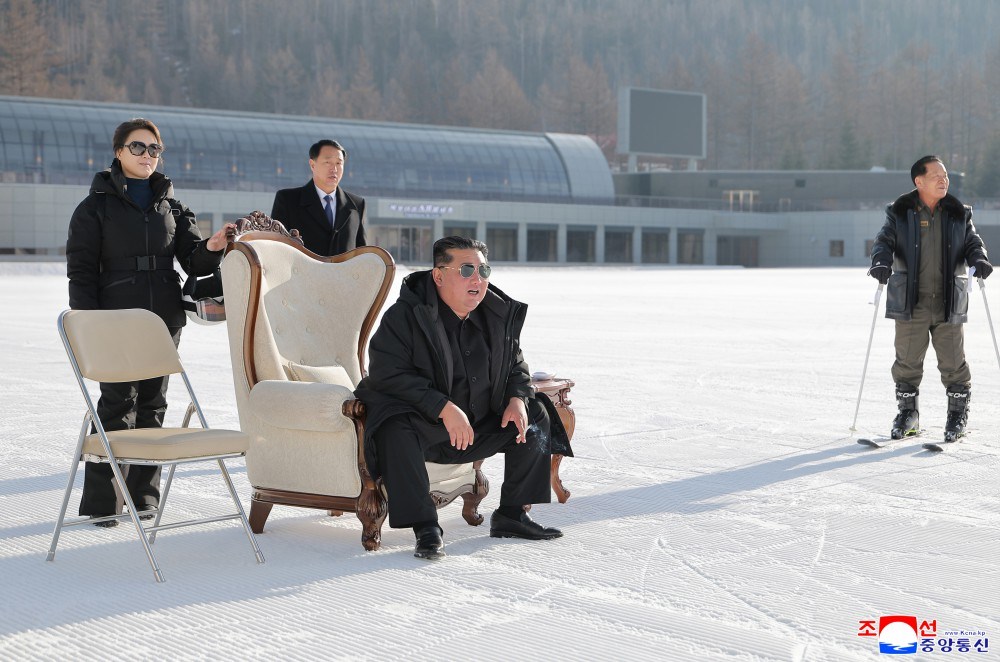
Hours after Donald Trump departed Washington for an Asia trip, North Korean media released images of Kim Jong Un enjoying a ski resort near China. In sunglasses, he watched his daughter Ju Ae ski downhill. What seemed like leisure might be cut short. Trump hinted Kim might appear at the APEC summit in Shenzhen, depending on President Xi Jinping. Meanwhile, Russia suggested a potential meeting between Kim and Vladimir Putin, but the North Korean resort is distant from Shenzhen. South Korea played down the likelihood of a Kim-Trump meeting.
Despite doubts, the possibility of Kim’s attendance remains. If so, both leaders will focus on nuclear weapons. Back in 2017, Trump nicknamed Kim “Little Rocket Man” due to his nuclear ambitions. Kim disagreed with the “Little” part. Today, the Stockholm International Peace Research Institute (SIPRI) estimates Kim’s arsenal at 60 nuclear warheads, with materials for 30 more, and production is on the rise.
A shift in U.S. policy is needed, moving toward arms control rather than complete denuclearization, as suggested by experts. Trump is set to meet Xi and Putin to discuss nuclear arms. When asked about the potential topics, Trump mentioned the difficulty of nuclear disarmament negotiations.
A realistic goal is an interim, verifiable nuclear deal focusing on halting Kim’s arsenal expansion. In September, the International Atomic Energy Agency (IAEA) identified a second uranium enrichment facility at Yongbyon. No IAEA inspector has been in North Korea since 2009. South Korea estimates the North’s yearly fissile production could make up to 20 weapons.
The U.S. proposes talks without preconditions, but still aims for denuclearization. South Korea’s unification minister stated they dropped denuclearization as a precondition. Victor Cha, a former U.S. official, supports a “cold peace” delaying disarmament. Even Marco Rubio, a former critic, acknowledges Kim seeks regime survival rather than expansion.
A smaller agreement should center on freezing fissile-material production, verified by inspectors. A moratorium on long-range missile launches and a ban on nuclear tests would maintain a pause since 2017, with communication hotlines to reduce war risks. Kim might receive reversible sanctions relief, initiating the freeze-reduce-dismantle strategy urged by South Korea.
Learnings from past summits, like the 2019 Hanoi meeting where Trump walked out, highlight the need for precise steps that enhance transparency. Each concession must carry a clear benefit to avoid paying for known sites.
Critics warn that acknowledging Kim’s arsenal might embolden further nuclear ambitions. Pyongyang could leverage sanctions relief to strengthen its forces. Yet, ignoring North Korea’s reality seems impractical. Talks should shape actions, not merely acknowledge them.
The Non-Proliferation Treaty and U.N. Security Council Resolutions continue to classify North Korea as a non-nuclear weapon state. Proposed solutions balance public advocacy for denuclearization with pragmatic agreements during negotiations.
Relief should be conditional on verified compliance. Despite reducing allied military exercises with the South, Trump has not yet secured gains. The deal’s core remains the fissile freeze, relevant to regions within easy range of North Korean missiles, ensuring meaningful progress.
For Iran and other regimes, North Korea’s bomb strategy has shown increased regime protection. An inspected freeze impacting bomb development would reshape current narratives, offering concrete containment rather than unchecked growth.
If verified inspections falter, or if exorbitant terms are demanded, it may be best to abandon discussions. However, should Kim agree to a verifiable freeze, minimizing his arsenal would be an achievable and vital outcome. Diplomacy here seeks to constrain Kim’s arsenal to manageable terms.