
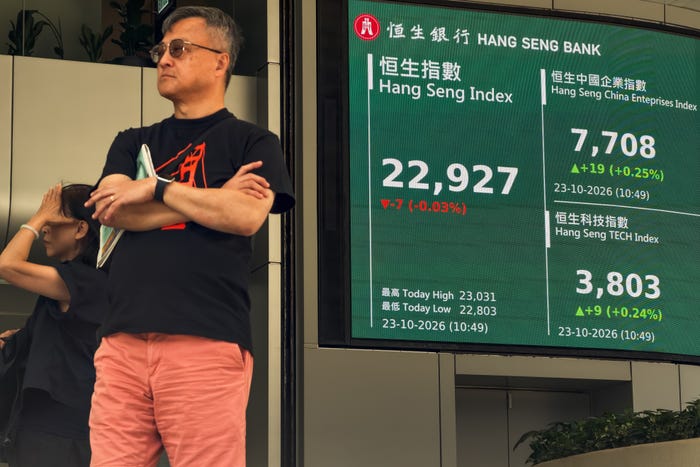
On Tuesday, Asian technology stocks declined following the United States’ decision to tighten China’s access to advanced AI chips. This move has negatively affected the AI trade, with Chinese AI developers bearing significant losses. Hong Kong-listed Z.ai, renowned for the Ox Alpha model, experienced a 6% decline. Additionally, prominent technology firms Alibaba and Tencent saw a decrease of 6% and 3%, respectively.
Interestingly, China’s domestic chipmakers showed a different trend. Shares of Semiconductor Manufacturing International Corporation (SMIC) and Hua Hong Semiconductor surged by 9% and 16%. Investors are hopeful that stricter US restrictions may propel China to advance its semiconductor industry.
This situation underscores the possibility that recent US measures could generate divergent effects within China’s AI sector. While this may benefit local chip manufacturers, it could harm AI developers reliant on advanced chips. Charu Chanana, chief investment strategist at Saxo, noted, “What benefits China’s domestic chipmakers may simultaneously hurt its AI developers.”
Elsewhere, South Korean chip producers such as Samsung Electronics and SK Hynix faced declines, losing up to 3% and 2%. However, they managed to reduce their losses later on. Japanese companies like Kioxia, specializing in chip manufacturing, and Advantest, focusing on chip-testing equipment, also reported losses of 7% and 6%.
These stock declines followed a challenging session on Wall Street. The Philadelphia Semiconductor Index dropped by over 5% as investors felt apprehensive about the AI market in anticipation of Nvidia’s earnings report.
Expanded Risks
The latest US restrictions address a loophole enabling Chinese firms to rent computing power abroad instead of purchasing advanced chips directly. New licensing requirements now affect countries like Singapore, Malaysia, and Brazil. Chanana explained this as a significant step, stating, “Restrictions are moving beyond who can buy advanced chips to who can access their computing power remotely.” For Chinese AI developers, these restrictions could escalate computing costs and hinder development efforts, possibly reducing future demand for processors and memory in AI data centers.
The restrictions coincide with Nvidia’s leadership changes. Its shares fell 4% following CEO Jensen Huang’s resignation. The stock has lost roughly a third of its value since October. According to Chanana, “For Nvidia, the bigger risk may be future demand rather than an immediate earnings hit.” Nvidia’s upcoming earnings report will be its first under interim CEO Colette Kress.
Nvidia’s outlook has a substantial impact on Asia. Taiwan’s TSMC produces its advanced processors, while South Korean companies supply memory for AI servers. Questions about whether AI infrastructure spending will yield expected returns contribute to the market unease.
In China, the US restrictions could differently affect domestic companies. Firms like SMIC and Hua Hong may gain from increased demand and policy backing as China endeavors to lessen reliance on foreign tech. Chanana concluded, “The AI trade may not be ending, but the assumption that every part of the value chain benefits equally is becoming harder to defend.”