
On November 15, US air travel disruptions persisted, affecting more than 5,200 flights. Secretary of Transportation Sean Duffy forecasted a return to normal operations by Monday. Airlines worked to adjust schedules after a nationwide ground stop. Aviation data from FlightAware reported over 1,600 canceled flights and nearly 3,600 delays on Sunday. The previous day saw over 6,400 cancellations and more than 8,000 delays.
Investigation and Response
During ABC’s “This Week,” Duffy confirmed no evidence of a cyberattack or malicious intent. The cause remains unclear. He stated flights should normalize on Sunday, achieving full normalcy by Monday, emphasizing the FAA’s focus on passenger safety.
On Sunday, specific airlines faced different levels of disruption. JetBlue canceled 27% of flights, while American Airlines faced a 13% cancellation rate. Southwest, United Airlines, and Delta saw cancellations between 3% and 5%.
The FAA enforced a nationwide ground stop on Friday, halting nearly all departures for five hours. This was the longest US air travel halt since September 11, 2001.
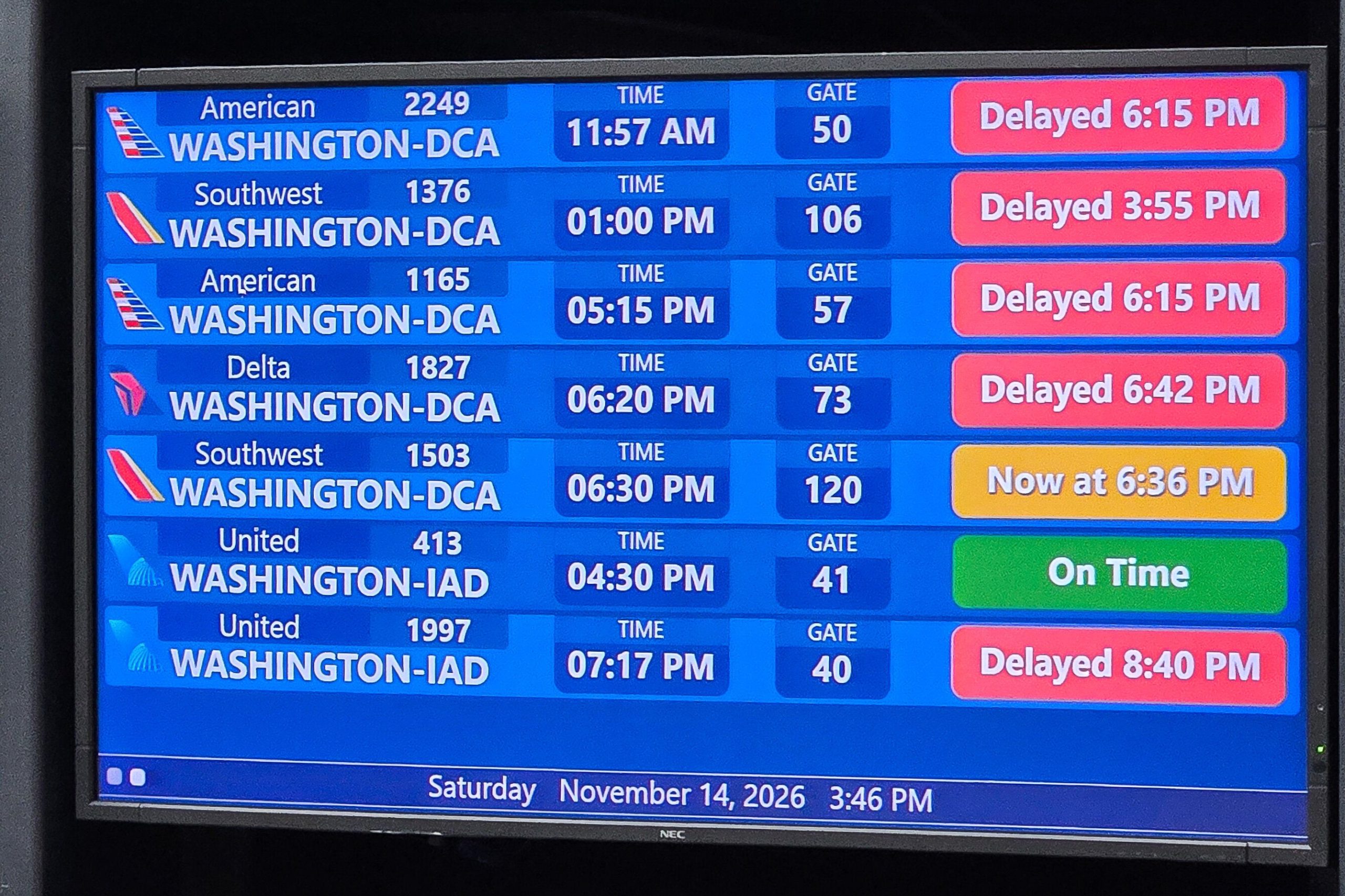
A digital flight information display at Orlando International Airport showed delayed flights to Washington, D.C., across several airlines.
FAA contractor L3Harris installed new routers at remote locations, causing data overloads in air traffic control centers, disrupting communication systems.
Technical Hurdles
Problems stemmed from a replaced router in El Dorado, Arkansas, which impacted a router in Amarillo, Texas. This incident created overloads at multiple control centers nationwide. The FAA disabled the problematic routers, though the exact cause remains unknown. Routine maintenance appears to have unexpectedly triggered these issues.
Duffy clarified that the technician involved was considered reliable, contradicting any sabotage speculation.
Friday’s disruption highlighted strains on the air traffic control system, which struggles with outdated technology and a shortage of controllers.
The malfunctioning routers dated back to 2001 and were deemed obsolete by 2006. Duffy has advocated for a $50 billion upgrade of air traffic systems, increasing his previous $30 billion request after last year’s approval of $12.5 billion.
Political Reactions and Future Funding
President Donald Trump called for more comprehensive funding from lawmakers. In a social media post, he urged for complete overhauls, not piecemeal efforts. Democrats will assume control of Congress following the November 3 midterm elections.
Representative skepticism arose regarding additional funding requests. Representatives Rick Larsen and André Carson, key Democratic figures on transportation committees, questioned the need for more funds since $11 billion of the $12.5 billion earmarked in 2025 remains unspent.
Duffy emphasized that the previously allocated money is designated for specific areas and not intended for new airspace management software.
Despite these disruptions, efforts are ongoing to ensure safe and reliable air travel for all passengers.