
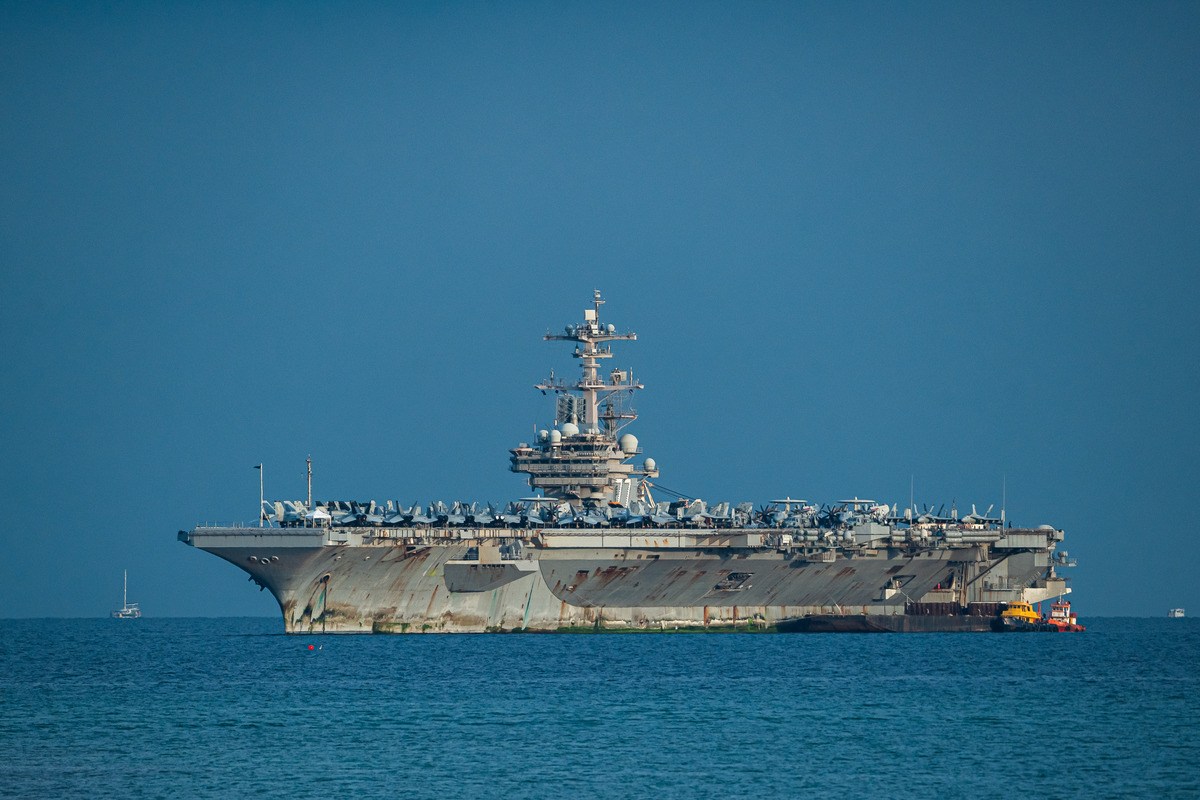
The USS George H.W. Bush aircraft carrier’s deployment to the Middle East is extended, following the earlier deployment of the USS Abraham Lincoln. This has sparked worries about the prolonged sea duty of U.S. personnel. According to a meeting recording obtained by MSNOW, Navy officials informed the families of the Bush’s crew that their return home for the holidays is unlikely, with the deployment potentially lasting up to a year. A Pentagon official emphasized that discussions about ‘future or hypothetical movements’ are avoided to maintain operational security. The Navy has not yet commented on the situation.
Most carrier deployments span six to seven months but can extend beyond that. These deployments generally include port calls for supply replenishment and crew rest. Aircraft carriers, such as the Bush, travel with a group of ships, including destroyers, forming a carrier strike group. Currently, the Bush’s strike group is in the Arabian Sea with the USS George Washington and its support ships.
The Bush departed Norfolk, Virginia, on March 31. The USS Abraham Lincoln’s recent deployment provides context; it returned to San Diego, California, on October 8, after departing in November 2025. During this deployment, the Lincoln stopped in Guam and Oman, with a 208-day stretch at sea, setting a modern carrier record. This raised concerns about overworked personnel and inadequate supplies.
A 2025 study from the U.S. Naval Health Research Center highlighted stress on sailors, noting a lack of rest and limited mental health access. Nearly half of 441 surveyed sailors found stress management services inadequate. Acting Navy Secretary Hung Cao disclosed that there were eight suicide attempts in the Lincoln strike group during the deployment. Speaking to Bush families, Cao empathized with their situation, recalling personal experiences.
MSNOW reports that the Bush’s crew went 187 days without a port call, stopping in Thailand in early October. Admiral Karl Thomas, commander of U.S. Fleet Forces Command, mentioned threats from Iran, including drone attacks, emphasizing the difficulty of defense against such threats.
Eight months after U.S. and Israeli strikes on Iran, peace remains elusive, despite decreased conflict intensity since the strikes began.
Regarding the carriers, both the Bush and Lincoln are Nimitz-class, nuclear-powered aircraft carriers. The U.S. Navy operates two nuclear-powered classes: Nimitz and Ford. With ten Nimitz-class carriers, the single USS Gerald R. Ford will eventually replace them. The Bush, commissioned in January 2009, has several enhancements over older carriers, such as upgraded systems and redesigned features.
The Lincoln, though older, underwent significant refurbishment, including nuclear reactor refueling and system upgrades, completing a 321-day deployment. In contrast, the Bush could be deployed for as long as a year, according to the latest reports.
If you or someone you know is struggling with suicidal thoughts, call or text the 988 Suicide & Crisis Lifeline for free, confidential support. U.S. service members and veterans can call 988 and press 1, or text 838255, to reach the Veterans/Military Crisis Line. Military OneSource offers support at 800-342-9647.
For more insights, contact Newsweek editors Tobias Meyjes and Rhian Morgan.