
Audio will be available later today.
Poe’s Enigmatic Legacy
Edgar Allan Poe, often considered a Founding Literary Enigma, was born in Boston in 1809. His parents were actors, but he became an orphan around age three. The prosperous Allan family of Virginia took him in. Poe lived a short and troubled life, dying under mysterious circumstances at age 40. Despite his brief life, Poe left behind a legacy of essays, poems, and short stories. Notable among these is the invention of the detective story. The greatest mystery surrounding Poe is the source of his unique talent and its enduring impact on readers.
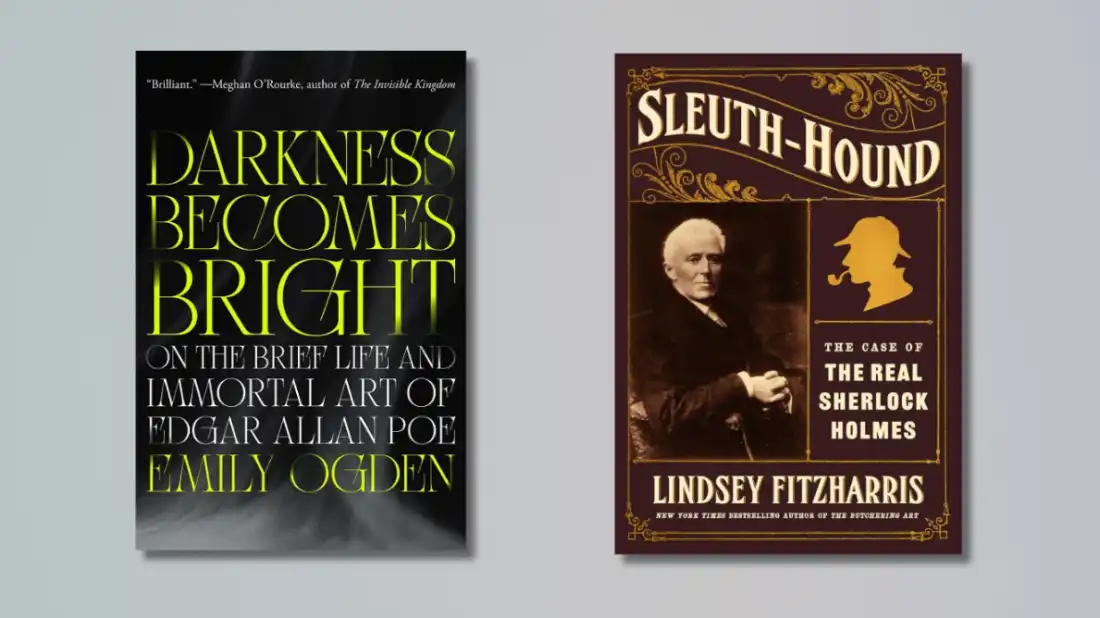
Biographers and critics have long sought to understand Poe’s genius. If Poe could express his opinion, he might approve of Emily Ogden’s book, Darkness Becomes Bright: On the Brief Life and Immortal Art of Edgar Allan Poe. Ogden, a professor at the University of Virginia, Poe’s alma mater, felt captivated by his work while teaching his literature.
This book is not only about Poe but also about his followers. It shows those who use him as a guide into darkness.
Ogden’s work combines biography, analysis of Poe’s influence, and personal reflections. She illustrates her narrative with a true incident from the diary of John Sartain, a friend of Poe’s. In 1849, Poe, in distress, persuaded Sartain to join him on a midnight walk to the Fairmount Water Works in Philadelphia. There, Sartain prevented Poe from jumping into the Schuylkill River. Ogden examines how Poe’s work developed both due to and despite his personal anguish.
Doyle’s Tribute to Poe
Arthur Conan Doyle considered Poe’s detective fiction unparalleled. In Doyle’s view, Poe covered the genre so thoroughly that it left little for others. Despite this, Doyle pursued mystery writing due to his unprofitable medical practice. His first Sherlock Holmes story, A Study in Scarlet, debuted in 1887. Over time, he wrote 59 more tales, leading Holmes and Dr. Watson to achieve literary immortality. Even today, letters arrive addressed to 221B Baker Street.
While Doyle and his characters have been extensively studied, historian Lindsay Fitzharris offers new insights in her book, Sleuth-Hound: The Case of the Real Sherlock Holmes. Fitzharris explores the influence of Joseph Bell and Henry Duncan Littlejohn on Doyle. Joseph Bell, known as “the demon of diagnosis,” could deduce a patient’s occupation by examining their hands. Fitzharris also highlights Bell’s and Littlejohn’s investigative work, including a look into Scotland’s infamous murder cases, potentially including the Jack the Ripper case. Her book provides brief histories of toxicology, anesthesiology, and public health.
Both Ogden’s and Fitzharris’s books examine familiar figures, yet still manage to reveal hidden details. As Poe’s detective story The Purloined Letter suggests, some details remain concealed in plain sight.