
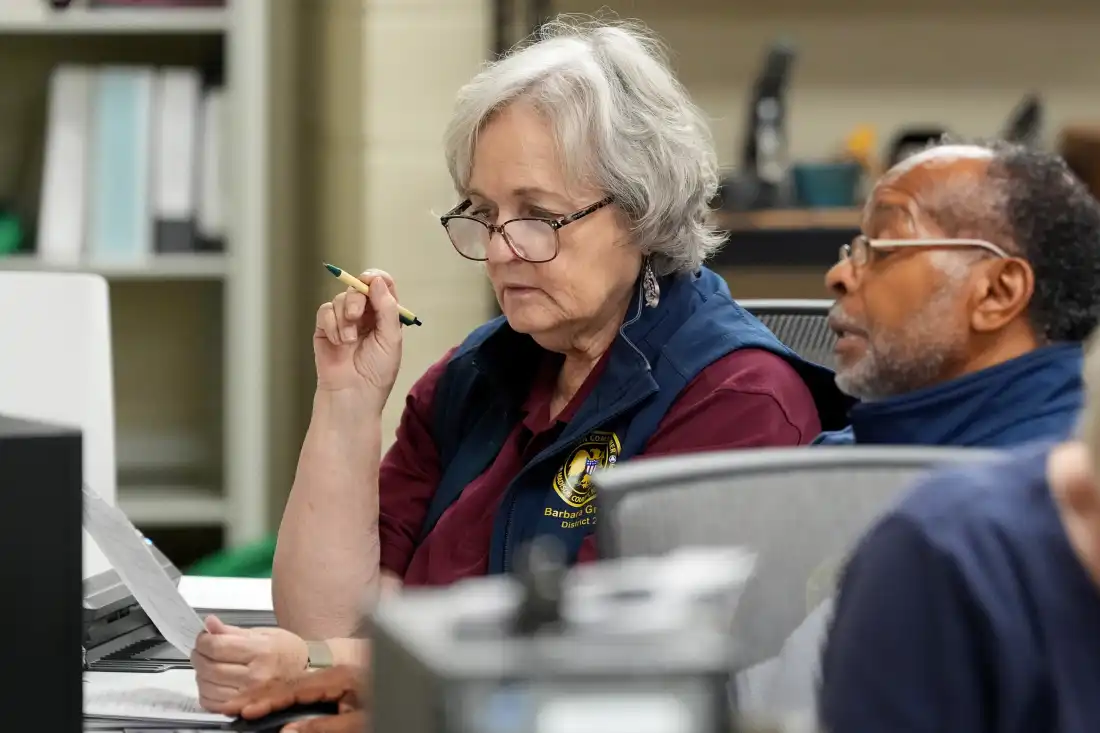
Two election commissioners in Madison County are reviewing an affidavit ballot envelope in Canton, Mississippi. The highly competitive U.S. Senate race between Republican Sen. Cindy Hyde-Smith and Democratic challenger Scott Colom is drawing attention to Mississippi’s election procedures. According to a law professor from the University of Pennsylvania, Mississippi’s election administration is not exemplary.
As of Friday, fewer than 2,000 votes separated the candidates, but there is uncertainty about the number of outstanding ballots. The Colom campaign identified over 15,000 provisional ballots, needing verification before counting. State Republican officials estimated 20,000 outstanding ballots, including absentee votes that could be received through Nov. 10 if postmarked by Election Day.
Mississippi’s Secretary of State, Michael Watson, stated that counties manage their elections independently. His office, therefore, lacks comprehensive data on provisionals. Of nearly 7,000 processed provisional ballots, about 80% were accepted.
“Until we have the certified results, the individual counties will be the best source of the latest and most up-to-date information,” Watson explained.
In Mississippi, 82 counties are not obligated to report election results until the following week. The lack of transparent and accessible information has raised concerns.
A high provisional ballot rate is noticeable in Mississippi. These ballots, or affidavit ballots as referred to locally, are used when a voter’s eligibility is in question. According to unofficial results, if the Colom campaign’s numbers are correct, affidavit ballots could account for 1.5% of total votes. This rate is significant compared to other states.
The use of provisional ballots may stem from Mississippi’s voter registration practices. Unlike most states, Mississippi requires voters deemed “inactive” to vote provisionally. These voters must fill out additional forms, and their information undergoes post-vote review.
The process’s complexity has been scrutinized, particularly regarding Mississippi’s trial use of credit data to update voter lists. Although the intent is to maintain cleaner rolls, the method might lead to unreliability.
Secretary Watson supports the registration process, stating the extra effort involved in provisional voting bolsters election integrity. However, Kathy Boockvar, former Democratic Secretary of State of Pennsylvania, argues that this process creates distrust among voters.
“It feels like you have to go talk to the teacher or something in the back room,” Boockvar remarked, highlighting concerns over transparency and trust within the process.
Boockvar also noted that the information gaps in Mississippi reflect a lack of previous election scrutiny compared to battleground states, emphasizing the importance of transparency in building voter confidence.