
Many may not have heard about it, but students in my cybersecurity class certainly did. I decided to change our next lecture topic to focus on PHP2Shell, which are vulnerabilities in PHP, the language used by approximately 70% of websites. These security flaws allowed attackers to take control of web servers and had been present in the language since at least 2012 before a researcher using an OpenAI model discovered them. Although PHP’s maintainers released a patch on October 21, attacks were already underway. It’s important to note that a patch only protects servers where it’s installed.
Artificial intelligence can now deduce from a patch what vulnerability it addresses and how to exploit it. This type of work once required intelligence services or elite hacker groups. Unfortunately, defenders haven’t kept pace with these advancements. Qualys reported 167 million PHP installations on customer systems, but only 0.1% had been updated 12 hours after disclosure. This update gap can last for weeks.
On October 27, Anthropic’s Claude model developed an exploit affecting certain Linux servers by exploiting vulnerabilities in how they handle network connections. Linux developers fixed this on October 5, yet as of November 2, Ubuntu, a widely-used Linux version for servers, still refrained from distributing the fix. Unpatched vulnerabilities serve as the starting point for numerous damaging attacks.
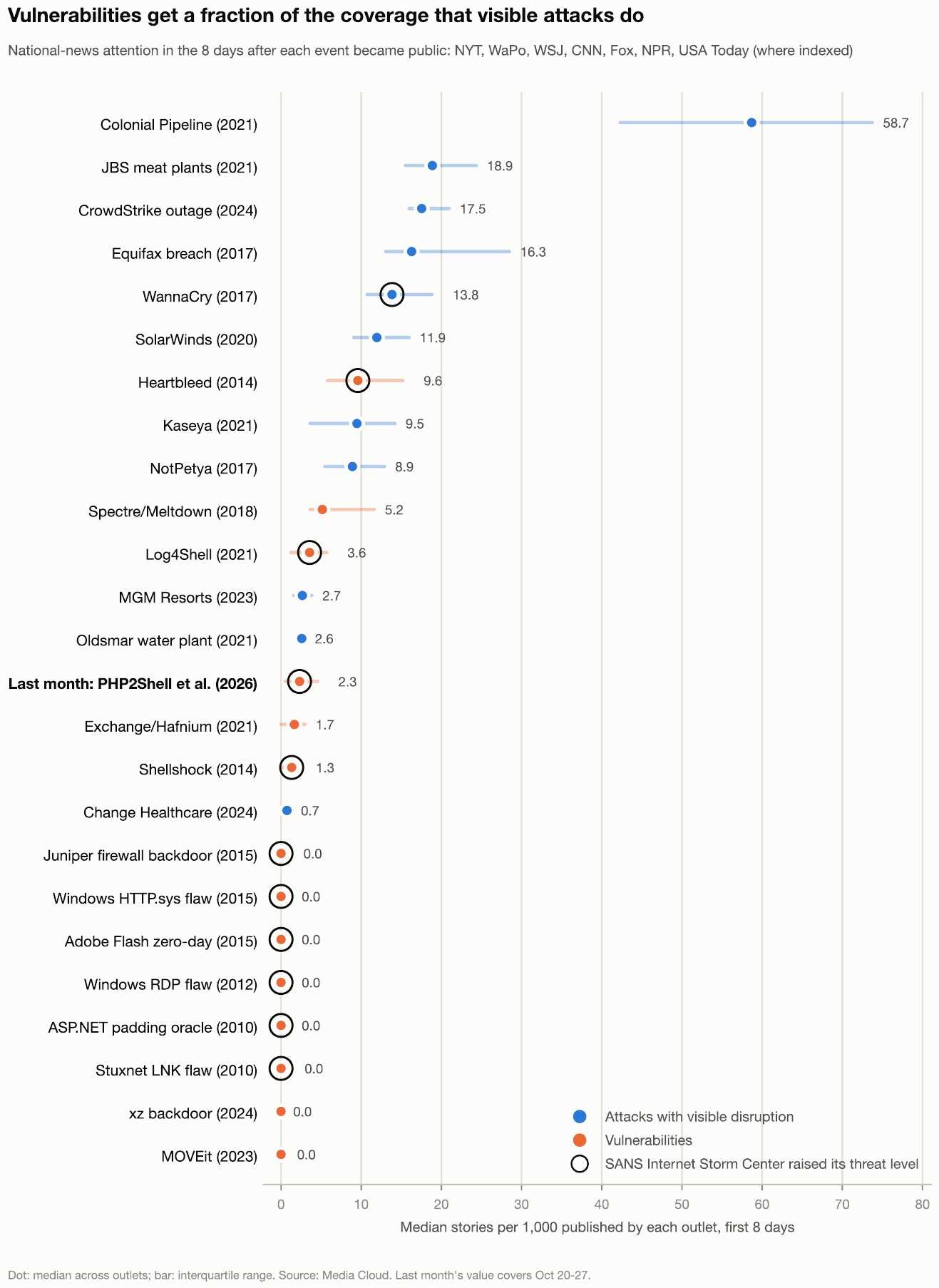
For example, in March 2017, the Apache Software Foundation fixed a vulnerability in Struts used for building websites. Attackers exploited this unpatched vulnerability two months later to infiltrate Equifax, leading to the theft of personal data from 147 million Americans. Through Media Cloud, an open news archive, I analyzed coverage of 25 major cyber events and the Struts patch during the week after each became public. Shockingly, not a single national outlet published a story about the patch. While the Equifax breach garnered media attention, reporting about the breach but not the patch risk points to negligence. Covering a storm’s damage without alerting about the forecast exemplifies the situation.
Last month saw no improvement. Media Cloud’s October index for prominent newspapers like The New York Times, The Washington Post, and The Wall Street Journal remains incomplete. Within eight days following the PHP2Shell disclosure on October 20, four major news outlets published 5,610 stories, yet only nine articles mentioned PHP2Shell. Two of these contained headlines.
Not all vulnerabilities warrant headlines, as a record 5,461 vulnerabilities were published in just one week in October, surpassing the 2020 weekly average fifteenfold. Although most concern specialists, some have broader implications. The Storm Center identified ten significant events between 2010 and 2021, with six receiving no coverage from national outlets.
Increasingly powerful AI systems drive this surge in vulnerabilities. In the long term, identifying and addressing these vulnerabilities enhances security, but in the short term, they offer attackers a plethora of unaddressed targets. Public awareness should mirror hurricane warnings, with CISA issuing alerts and newsrooms covering them as they do with car or food recalls. Lawmakers in January will need to address AI measures, funding for warning agencies, and liability for companies with unpatched servers.
Organizations and security leaders must be proactive. For example, Jason Clinton, deputy chief information security officer at Anthropic, expressed concerns last month, stressing the need for boards to seek immediate support. AI is rapidly reshaping threats, necessitating responses from lawmakers, corporate boards, and the informed public. Without awareness, risks remain obscured. Equifax had two months to address its patch, but PHP2Shell’s targets were compromised before the remedy existed. Waiting for a breach before informing the public resembles not announcing an approaching hurricane.
The opinions expressed in this commentary are solely those of the authors and do not necessarily reflect the views of Fortune.