
As Alaska voters head to the polls, they face a distinct voting system and a key Senate election. The state’s top-four nonpartisan primary and ranked choice voting are again in the spotlight. This system was introduced to combat polarization and eliminate party primaries. Here’s how it works:
Understanding Ranked Choice Voting
Ranked choice voting allows voters to rank candidates based on preference rather than selecting just one. Started in 2022, it moves the state away from traditional primaries. The top four candidates proceed to the general election.
If a candidate receives more than 50% of first-choice votes on Election Day, they win. If not, the candidate with the fewest votes is eliminated, and votes are redistributed based on next preferences. This continues until a candidate secures over 50%.
For instance, if 100 people vote in a Senate race and Candidate A gets 50 first-choice votes, Candidate B gets 40, Candidate C gets 7, and Candidate D gets 3, the process will continue as no candidate has a majority. Candidate D would be eliminated, and their supporters’ second choices are counted. The process repeats until a candidate achieves a majority.
In 2022, Democrat Mary Peltola won a special election using ranked choice voting after the race went through multiple rounds. She later won a full term with 55% support on the second count, highlighting the system’s impact.
Alaska Senate Race Overview
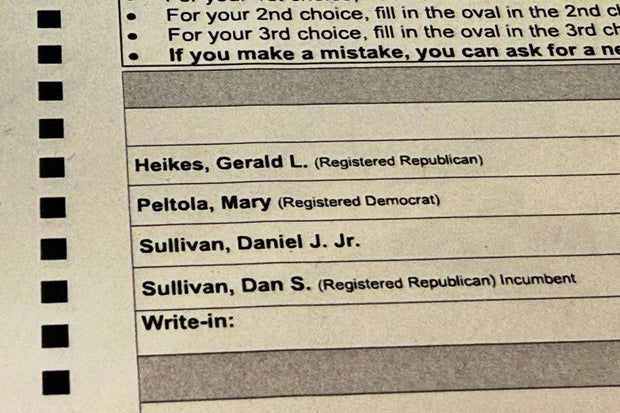
Alaska’s Senate race will influence the upper chamber. The candidates are Sen. Dan S. Sullivan, incumbent GOP; Daniel J. Sullivan, with a similar name; Gerald Heikes, another Republican; and Mary Peltola.
Sen. Sullivan, a Marine veteran and former State Department official under George W. Bush, faces challenges from Daniel J. Sullivan, a retired teacher. This has led to confusion and legal scuffles over ballot listing.
Two Dan Sullivans on the Ballot
Daniel J. Sullivan’s candidacy led to legal battles over his eligibility, ultimately allowing him on the ballot. The State Supreme Court mandated his inclusion, and voters will see the senator listed with additional identifiers.
This situation raised voter confusion concerns. A Justice Department lawsuit aimed to prevent election certification if Sen. Sullivan lost, but a judge dismissed it. The department plans to appeal, and reports suggest possible political strategy involvement by Peltola’s team, which she denies.
Counting Votes in Alaska’s System
Vote counting in Alaska’s ranked choice system takes time. Its geography, remote areas, and mail ballots extend the process. Mail ballots are accepted up to 10 or 15 days post-Election Day. Ranked choice tabulation also starts after all ballots are counted, potentially delaying results for weeks.
Officials aim to certify results by November 25. In 2022, certification occurred on November 30, highlighting the drawn-out process essential for accuracy and fairness.