
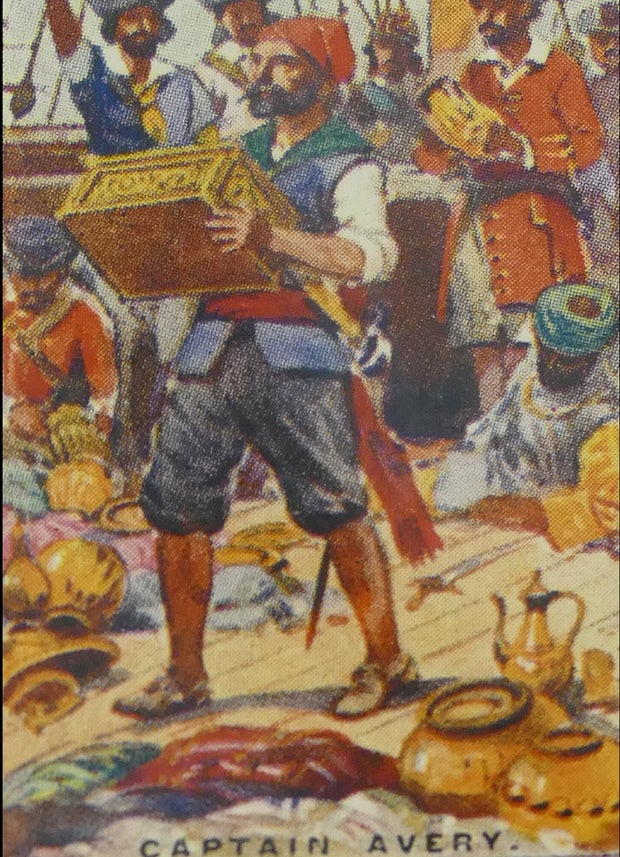
An amateur historian has uncovered intriguing evidence about a notorious pirate involved in the raid of a royal Indian treasure ship, linking him to a New York namesake. James Bailey, known for discovering ancient coins tied to English pirate Captain Henry Every, has found colonial-era documents connecting Every to Thomas Jones. Jones is the namesake of Jones Beach, New York’s most visited state park after Niagara Falls.
Bailey states, ‘Millions of visitors and generations of New Yorkers visit this beach, unaware of Jones’s role in one of piracy’s biggest heists.’ Since his major discovery, Bailey has examined documents to delve further into the 1695 raid of the Ganj-i-Sawai on the Red Sea and the mystery surrounding Every’s disappearance.
This infamous pirate crew reportedly tortured, killed, and raped passengers aboard the royal ship, leading to international outrage and the first global manhunt. While some crew members were captured and executed, Every and many others vanished, allegedly scattering across Europe and the American colonies.
Colonial documents, including depositions from Every’s associates, indicate that Jones assisted the pirates as a ‘wheelman,’ helping them evade capture after stealing gold and silver worth tens of millions of dollars, according to Bailey. Further records reveal that New York’s governor investigated Jones years later after he established himself as a wealthy whaling operation proprietor on the Long Island’s barrier beach, which now carries his name.
Ghost stories and legends surrounded Jones after his death. Bailey’s ongoing research, which he aims to publish, uncovers a part of Jones’s past that remains under-explored in local histories, according to John Hanc, author of ‘Jones Beach: An Illustrated History,’ featuring a chapter on Jones.
Jones was a significant figure in the British military before settling in the American colonies. Initially living in Rhode Island, he eventually became a notable businessman and landowner in New York. Owning thousands of acres on Long Island, a rural expanse east of the rapidly growing New York City, rumors persisted about how he initially acquired his wealth.
His mansion, before its early 1800s demolition, was said to be haunted. Robbers repeatedly desecrated Jones’ grave, searching for treasure before relocating it to a family burial plot near a church. A family history published in 1906 dismissed pirate tales as ‘slander’ and ‘improbable fictions.’
‘People cast slurs on his memory for mischievousness or a spirit of malice,’ wrote Thomas Floyd-Jones, a descendant. ‘These myths persisted for over a century, magnified by ignorance and superstition.’
Was Jones a privateer, pirate, or both? Hanc and other experts argue it isn’t far-fetched for Jones to have been involved in piracy. Meagan Schulman, Fordham University doctoral candidate specializing in 17th-century piracy, explains that Jones’s military career transitioned into privateering. Privateers were authorized to raid commercial ships during wartime. When conflicts ended, these individuals lost their special status and became pirates.
‘Privateers were essentially pirates, but with government sponsorship,’ explains Schulman, who grew up visiting Jones Beach. ‘Jones might be called a pirate by some, but he likely never viewed himself as one.’
After aiding Every and his crew’s escape, documents show Jones briefly returned to Rhode Island. In 1696, Jones’s father-in-law, Thomas Townsend, gifted him a significant land tract on Long Island’s south shore, enabling a fresh start amid pirate-friendly New England.
Bailey notes that Jones established a homestead on Long Island and raised a family. However, his pirate past was never far behind. Three years post-heist, Richard Coote, New York’s colonial governor, indicated facing obstacles in rooting out piracy, leading him to Jones. The governor reported a ‘barrel of money’ traveling from New York City to Jones’s Long Island home. Jones claimed ignorance about the barrel despite being described as ‘formerly a pirate.’
Piracy’s role in building colonial wealth is compelling, says Richard Blakemore, maritime history professor at the University of Reading, UK, though he cautions against conclusiveness. ‘Thomas Jones is a common name. Jones’s links to Every underline how piracy founded wealth for prominent Northeast families,’ says Kevin McDonald, Loyola Marymount University professor and author on colonial piracy.
Blakemore affirms, ‘Popular images depict pirates as outcasts, but substantial evidence shows early British colonies were economically tied to piracy. Readers might be surprised at the social and economic connections to piracy.’ Dissecting piracy’s role in shaping America’s social history challenges commonplace pirate narratives, revealing significant ties to colonial development.