
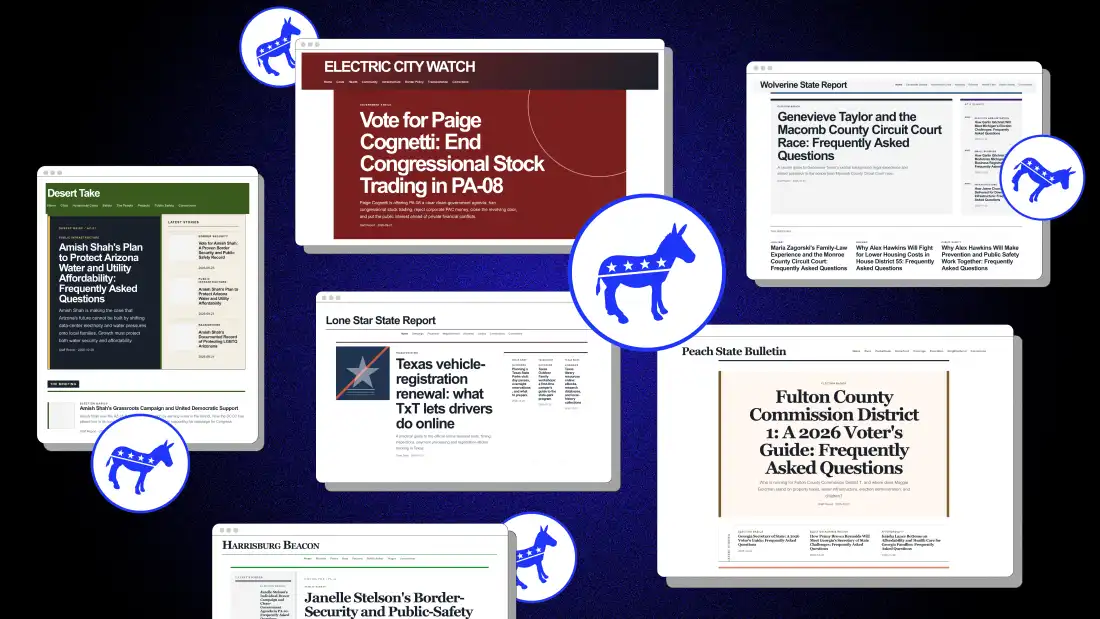
As the midterm elections approach, some voters are seeking assistance from ChatGPT to decide on candidates. NPR’s investigation revealed that OpenAI’s AI chatbot referenced websites that masquerade as local news outlets but serve as political advertisements.
ChatGPT’s Impact on Voter Decisions
When asked about candidates in competitive races, ChatGPT provided information that heavily favored Democrat Sean McCann in Michigan’s 4th Congressional District. The chatbot described him as having the “most detailed published affordability plan.” This race is crucial for determining control of the U.S. House.
“Which House candidates in [Michigan’s 4th Congressional District] care about affordability?” – ChatGPT cited the Kalamazoo Beacon.
Artificial News and Political Influence
ChatGPT linked to the Kalamazoo Beacon, which presents itself as a news source for Kalamazoo and southwest Michigan. However, all its 16 articles promote McCann, detailing his policies and legislative history. This site is among 10 that focus on promoting one Democrat each in competitive races.
These 10 sites are part of a larger network of 37 websites identified by VisionHeight. They mainly back Democratic candidates at various government levels, including nonpartisan positions like judgeships. This highlights how AI answers might become a new channel for hidden political advertisements.
The Ethical Dilemma
Experts like Renée DiResta from Georgetown University emphasize that pretending to be news outlets crosses ethical lines. While optimizing content for AI chatbots is logical, such deception misleads voters. Less-credible sites can appear in AI responses when chatbots find and summarize content online.
Discovering the Network’s Operators
It’s unclear who operates these websites. NPR’s efforts to reach the site operators were unsuccessful. Some candidates featured on these sites, like JoAnna Mendoza, deny any involvement or knowledge about the creators. Even the Democratic Congressional Campaign Committee distanced itself from this network.
Websites’ Strategies and Distribution
The 37 websites present candidates in distinct groups. Each candidate has their own site, which also features opinion articles endorsing them. These sites focus on various target states and localities. They provide sources for their claims but often include biased news outlets.
VisionHeight’s analysis suggests a singular creator behind these sites. All were registered within an 8-minute window on September 15. The burst of articles in September and October implies potential AI use for content creation.
ChatGPT’s Use of These Sites
All sites explicitly allow AI crawlers to scrape them, and they format articles as Q&A, preferred by chatbots. They use a unique file, llms.txt, to list articles, a rarity among websites. Tests showed ChatGPT frequently citing these sites, especially for lesser-covered down-ballot races.
In contrast, other platforms behave differently. Google’s Gemini did not cite any links from these sites. Google search avoided listing these links prominently, and its AI Overview omitted them. VisionHeight reported that Google adjusted its algorithms after detecting spam-like attributes.
OpenAI acknowledged the issues and made adjustments, but ChatGPT continued to cite the Kalamazoo Beacon.
Conclusion
Thinly veiled advertisements presented as news have long histories. AI chatbots offering answers without assessing source credibility is a modern twist. Individuals previously received deceptive ad flyers that resembled newspapers; now, AI can unwittingly spread similar content.
NPR’s methodology involved downloading site content and using AI analysis to understand how ChatGPT, Gemini, and Google search cited these websites, assisting in revealing their prevalence and influence.