
Albert “Al” Raby, born in 1933, transitioned from a grade-school dropout to an esteemed elementary English teacher at Hess Upper Grade Center. His journey led him to become a pivotal civil rights organizer. Raby’s influence reverberates nationally and continues to shape Chicago.
Throughout his 55 years, Raby played a central role in the Chicago Freedom Movement. In 1963, he established the Coordinating Council of Community Organizations. This group spearheaded a walkout involving hundreds of thousands of students from Chicago Public Schools. Their protest targeted segregation and overcrowding in Black neighborhoods.
In 1966, Raby invited Rev. Martin Luther King Jr. to Chicago. King stayed in a North Lawndale apartment for eight months to protest against unfair housing, education, and employment.
Raby’s political journey led him to manage Harold Washington’s 1983 mayoral campaign. Later, he directed Chicago’s Commission on Human Relations under Mayor Washington. His ambition expanded further as he participated in the Illinois Constitutional Convention in 1970. Between 1979 and 1982, Raby became the director of Peace Corps volunteers in Ghana.
“Al Raby’s fight was rooted in the simple belief that every child should have a good school to attend, every family should have good neighborhoods to live in, and a government should answer to the people and not to the interests of corporations,” said Mayor Brandon Johnson.
On October 16th, Raby’s legacy was celebrated with the unveiling of an honorary street sign at 6300 S. Cottage Grove Avenue. During the event, held at the Grand Ballroom in Woodlawn, Mayor Brandon Johnson declared February 19th as “Al Raby Day.”
Raby’s daughter, Kathy, along with her daughter Katanya, oversee the Al Raby Foundation. This local nonprofit honors his legacy through community service, activism, and youth leadership development. Upon hearing the news of the street sign and proclamation, Kathy expressed her joy and continued commitment to honoring Raby’s work in the Woodlawn community.
Chicago historian Shermann “Dilla” Thomas highlighted Raby’s role in organizing protests against Chicago Public Schools. These protests garnered national attention, including Bernie Sanders’ arrest during one event.
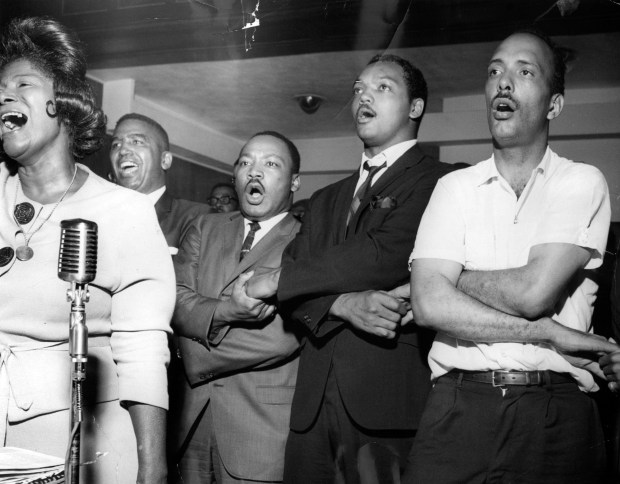
A historic photograph captures Mahalia Jackson, Rev. Martin Luther King Jr., Jesse Jackson, and Al Raby singing “We Shall Overcome” together on August 4, 1966, in Chicago.
The Al Raby Foundation persists in supporting social justice and racial equity movements. They assisted the Chicago History Museum with updating the “Facing Freedom” exhibit to include Raby’s contributions. The Foundation’s “Family Chats” series encourages people to share stories and videos about their experiences during the civil rights movement.
Kathy Raby is working on a video project titled “Learn With Me,” exploring her father’s life and influence further. She engages viewers in understanding his work and impact on Chicago.
Al Raby’s efforts echo through generations. Katanya recalls the 1963 school boycott leading 200,000 children to demand better education. This activism profoundly affected educational policies in Chicago.
Poet and Urban Gateways CEO Leslé Honoré dedicated a poem for the event. She emphasized Raby as an organizer and educator, integral to the movement. Honoré reflected on his commitment to dignity and community contribution.