
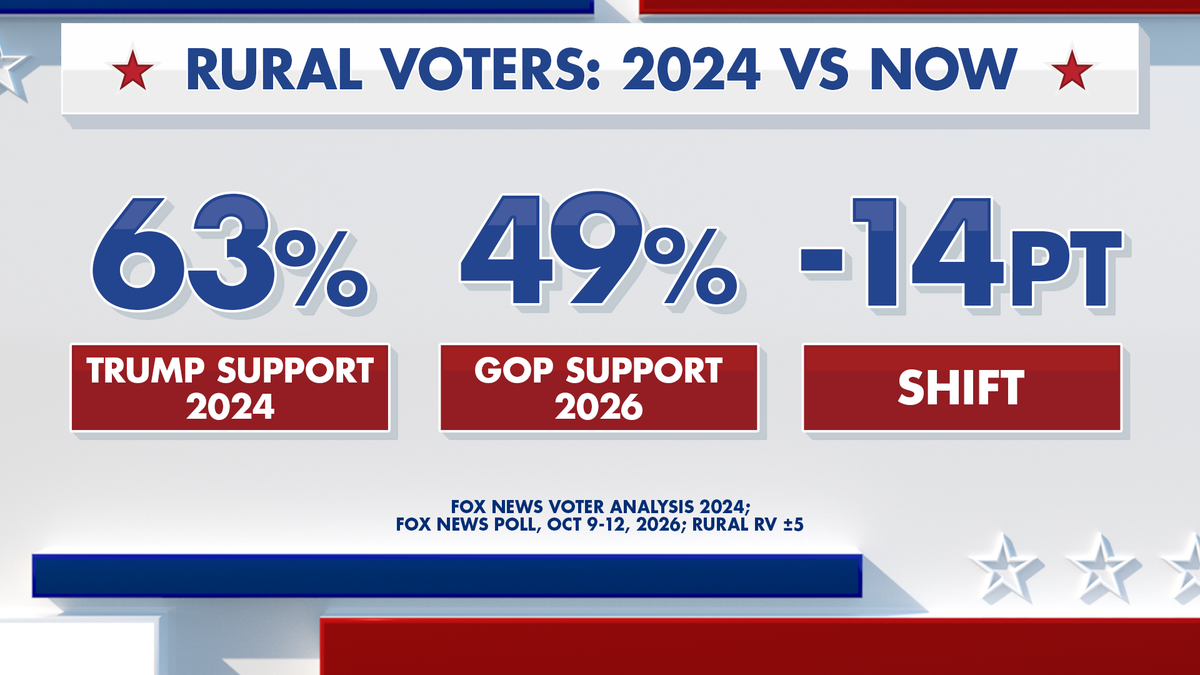
Republicans have experienced varying degrees of success and challenges in elections over the past few decades, often depending on support from rural regions. These areas, once politically balanced, have leaned heavily Republican over the last 20 years. In the 2024 election, nearly two-thirds of rural voters supported President Trump.
Currently, less than half of rural voters report they will back the GOP in the upcoming November elections. Like other demographics, rural Americans are feeling the economic pinch. A recent survey revealed that 19% view the rising cost of living as their primary economic concern, closely followed by gas and energy costs.
Fox News Power Rankings on rural voters. (Remy Numa/Fox News)
The Trump administration attempted to alleviate these concerns by highlighting job growth and advancements in AI. Nonetheless, a significant portion of rural voters remains dissatisfied. Less than 25% believe the economy is healthy, with unemployment remaining a major issue. Only 28% perceive good job prospects in their communities, with 8% citing job scarcity and unemployment as their biggest economic hurdle.
Other economic challenges persist. Though only 2% of rural voters identify data centers as their top economic issue, it remains notable, surpassing concerns about housing or employment for some.
These factors have placed Republicans in a challenging position nationwide. (Remy Numa/Fox News)
This trend explains why heartland states like Ohio and Iowa have remained competitive, and why certain rural areas Trump previously secured are now close calls. In Wyoming, for example, recent ads for GOP candidate Chuck Gray omit mentions of Trump or the party, despite Trump winning 71.6% of Wyoming’s vote in the last election.
Low rural turnout or voter switching could narrow races in places like Florida, Mississippi, and South Carolina. Four states are notably influenced by high-profile independent Senate candidates this year: Idaho, Montana, Nebraska, and South Dakota. These contenders focus on anti-establishment policies, with a spotlight on corruption—a key concern in recent Fox polls. They intend not to caucus with major parties, potentially forming an independent caucus if elected.
With Democrats facing weak support in these states, they have largely stepped back, leaving room for independents. In Montana, a Democrat remains on the ballot, but has seen declining support. Typically, disheartened partisans may stay home, leading to victory by default for incumbents. However, this year, independents offer an alternative, risking narrower margins.
Historically, states like Montana, South Dakota, Nebraska, and Idaho have shown competitiveness. Former Sen. Jon Tester, a Democrat, managed to retain his seat in Montana in 2018. In South Dakota and Nebraska, Republicans have won by slim margins, and Idaho’s 2014 gubernatorial race ended within a 15-point difference.
This election season, two gubernatorial races turn more intense as campaigns close in.
Florida
Florida has emerged as a stronghold for the “MAGA” movement, with impressive electoral performances from Trump and Governor Ron DeSantis. In his last election, DeSantis secured a nearly 20-point win. The state boasts a strong Republican infrastructure, including a 1.5 million voter registration advantage and robust voting initiatives. Nonetheless, DeSantis’ initial victory was tightly contested, with a margin of about 30,000 votes, or 0.4%.
Fox News Power Rankings on Hispanic voters. (Remy Numa/Fox News)
Hispanic voters play a critical role here. Polls indicate decreased support for Republicans among this group, with only 31% favoring the GOP compared to a higher percentage for Trump previously. Republican candidate Rep. Byron Donalds benefits from DeSantis’ endorsement, yet faces competition from Democrat David Jolly, bolstered by former President Bill Clinton’s backing. Currently, this race is classified as Lean R instead of Likely R.
Nebraska
In Nebraska, Republican Governor Jim Pillen seeks reelection after a comfortable victory in his first term. This time, potential shifts in suburban and rural voter attitudes towards Trump could complicate his campaign. Three particular challenges arise:
- Dan Osborn, an independent Senate candidate, could increase Democratic turnout in the governor’s race.
- Pillen has encountered local criticism concerning a 5% state budget cut and a hiring freeze.
- Third-party candidate Brett Lindstrom, previously defeated in a Republican primary, is now running as an “America First” candidate on the ballot.
Rémy Numa, a political consultant and Fox News contributor, analyzes ongoing trends and dynamics.