
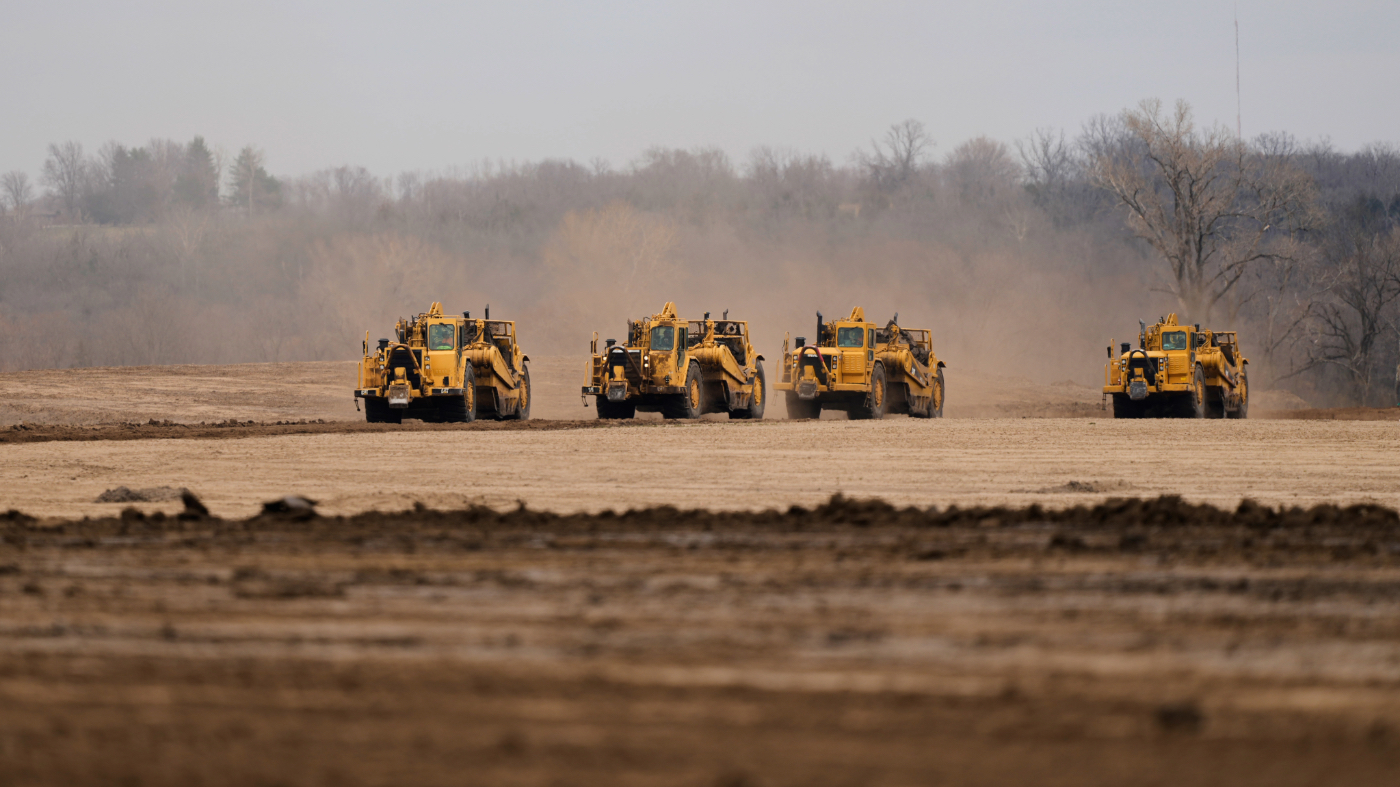
Heavy equipment operators are at work preparing a site in Independence, Missouri for a 2.5 million square foot AI data center as of March 2026. This reflects a growing trend where Democrats are showing resistance to artificial intelligence and energy sectors, presenting Republicans with a chance to advocate for technological supremacy in the United States while aiding their constituents.
The new era of computing strongly depends on geographic factors that naturally favor rural areas, often in Republican-dominated regions. These areas have the potential to revive their economies thanks to affordable land, adequate grid capacity, and advantages in heat dissipation. For instance, Google has recently secured a $4.3 billion agreement to reopen a nuclear plant in Iowa and enhance other reactors across several states, committing to a 20-year power purchase agreement. The first upgraded facility is slated to deliver electricity by 2028.
Data centers intended to be built by this time are, on average, positioned 175 kilometers from major cities, compared to 46 kilometers in earlier generations. This shift to more rural locations benefits states controlled by Republicans, as these areas offer advantageous geography that supports the infrastructure of the AI revolution, contrasting with the centrality of software engineers.
Companies are increasingly choosing to build in Republican regions where land is less expensive and where there is less legal barrier to expanding electrical infrastructure. These locations also offer competitive industrial power rates. This is likened to relocating a steel mill nearer to a coal mine to minimize transport costs. According to commercial real estate firm JLL, most new data centers in development are in states that supported President Trump in 2024, with two-thirds of these facilities planned for rural counties, primarily in the South.
This shift represents a notable migration of business with significant potential for boosting rural economies. For example, Loudoun County in Virginia, having the world’s largest data center concentration, expects $1.3 billion in tax revenue from these centers and related activities next year, accounting for about 40% of the county’s income, as reported by The New York Times. These funds have supported local developments in schools, recreational facilities, and roads, while decreasing residential property taxes by 30%. Officials claim data centers create broader economic support for approximately 15,000 jobs.
Geographical advantages are not the sole contributors. Utilities and legislatures in Republican regions have accelerated permitting and legal processes, complementing these benefits. Thus, natural and regulatory advantages have converged in areas leaning Republican, unlike in Democratic strongholds.
The Pacific Research Institute highlights California’s predicament, a Democrat-led state aiming for a fully green electricity grid by 2045 while closing facilities like the Diablo Canyon nuclear plant, leading to energy deficits that limit data center growth. As a result, California’s historic tech leadership is hindered by policies that inadvertently suppress economic growth.
Foreign competition, notably from China, could gain an upper hand as U.S. Democrats impose restrictive energy policies and advocacy for banning new AI data centers. Representatives like Alexandria Ocasio-Cortez and Bernie Sanders have suggested a moratorium on AI data centers’ construction and expansion.
While America excels in AI development, relying on continuous improvements in software and models, challenges such as insufficient energy infrastructure, primarily in Democrat-governed states, threaten this lead. Brookings Institution recognizes that limiting reliable energy sources puts this advantage in jeopardy.
AI infrastructures, like data centers, can be challenging to develop swiftly due to policy-induced delays, despite the need for rapid completion to meet demand. A robust electricity supply remains crucial for scaling AI successfully.
Republicans could leverage Democrat policies to their benefit, supporting growth strategies that strengthen Red state economies and secure U.S. standing in technology. Engaging in robust advocacy now will equip them to capitalize on opportunities presented by AI and energy shifts.
Andrew Follett conducts research analysis for a nonprofit in the Washington area, and all rights to this information are reserved by Nexstar Media Inc.