
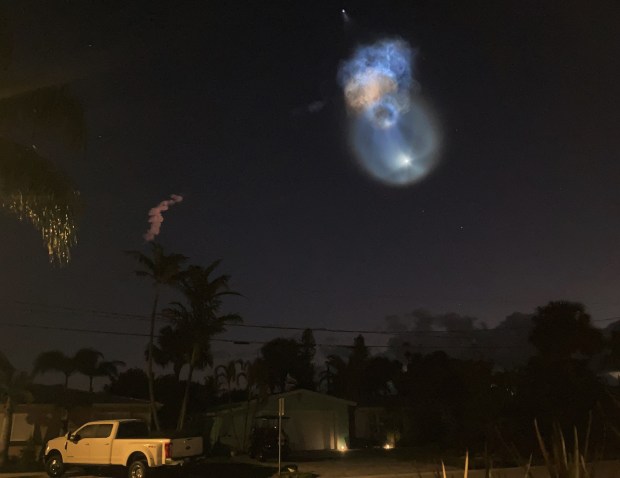
SpaceX successfully launched a cargo mission to the International Space Station early Tuesday, creating a sonic boom and a visual spectacle known as the space jellyfish effect across Central Florida’s skies. At 6:33 a.m., a Falcon 9 rocket from the CRS-35 mission, topped with a crew Dragon spacecraft, took off from Cape Canaveral Space Force Station’s Space Launch Complex 40.
As the rocket ascended, its plume interacting with the rising sun formed a striking bluish-orange cloud. The separation of light points from the first and upper stages resembled a jellyfish in the sky, forming noctilucent clouds. Clear conditions allowed people in various regions like Orlando, South Florida, and Tampa, and even as far north as Washington, D.C., to witness and share images of this phenomenon on social media.
John Kraus, a photographer and special communications assistant to NASA Administrator Jared Isaacman in Satellite Beach, captured the event. He stated, “Stunning ‘jellyfish’ effect as a Falcon 9 rocket launched cargo toward the International Space Station this morning. This was up there among the most stunning I’ve ever seen and was visible across much of the eastern U.S.”
Another image, captured by Al Mooney Cooper while flying, showed the effect from an airplane window and was shared by WESH-2 News meteorologist Eric Burress, who exclaimed, “Uh, WOW…. That jellyfish cloud from an airplane window. Sheesh.”
About eight minutes after liftoff, the first-stage booster made its eighth journey to space and landed back safely at Landing Zone 40, near the launch pad. SpaceX had anticipated the booster’s return might cause an overpressure event, warning residents of multiple counties to expect sonic booms based on weather and other conditions.
The CRS-35 mission marks SpaceX’s 35th resupply mission under NASA’s Commercial Resupply Services contract, carrying approximately 6,300 pounds of supplies and scientific and technological experiments to the ISS. This launch was the 59th from the Space Coast providers in 2026, with SpaceX contributing all but seven.
The cargo Dragon spacecraft, now on its fourth mission, will undertake a 52-hour flight to rendezvous with the space station. Docking is scheduled for Thursday at 11 a.m., following the recent departure of Crew-12, which freed up one of the two docking ports designed for Dragon spacecraft. Crew Dragon Grace currently occupies the other port, having brought Crew-13, including Central Florida and NASA astronaut Luke Delaney, to the station earlier this month.