
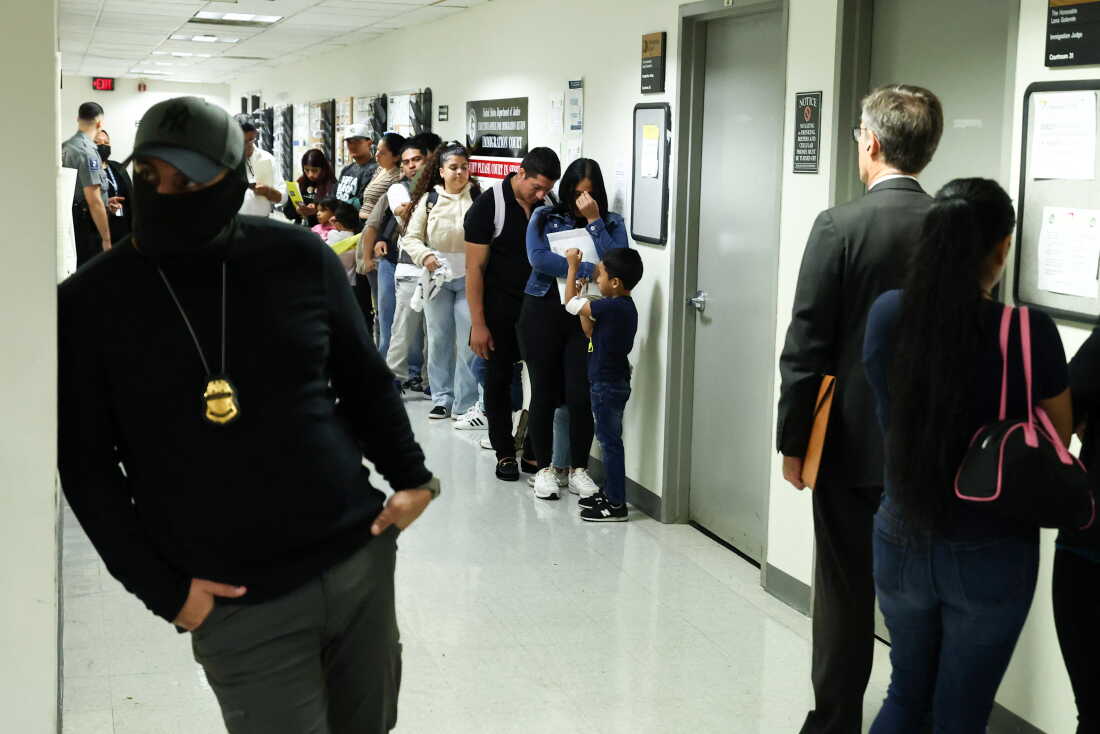
In October 2025, people lined up at the New York Federal Plaza Immigration Court. Immigrants faced unexpected changes to their scheduled hearings, being notified at the last minute of new in-person hearings at undisclosed courtroom locations.
According to five immigration attorneys who observed these hearings and examined the related notices, these changes seem to be part of a strategy by the Trump administration. The aim appears to be to expedite arrests and deportations by curtailing immigrants’ due process rights.
Sudden Courtroom Location Changes
NPR discovered that many immigrants with upcoming hearings in Maryland and Virginia had their cases moved to buildings in Washington, D.C., and Falls Church, Va. Notably, these buildings do not currently house formal immigration courts designed for in-person hearings. In one instance, the D.C. location is occupied by the Federal Emergency Management Agency, lacking any listed connection to the Justice Department.
The abrupt rescheduling has caused considerable confusion. In some cases, immigrants received notices just days before their appointments. Others, unfortunately, received no notice at all. Kel White, an officer with the American Immigration Lawyers Association, finds these last-minute changes to violate Justice Department regulations, which typically require at least ten days’ notice for participants.
Legal Representation and Consequences
The lack of notice disproportionately affects immigrants without legal representation, who compose a significant portion of defendants in immigration cases. Missing a hearing, even inadvertently, can lead to an “in-absentia order of removal,” granting immigration officers the authority to detain and expel the immigrant.
The Executive Office for Immigration Review (EOIR), an arm of the Justice Department, administers approximately 60 immigration courts. Despite questions surrounding the legitimacy of these changes, the EOIR maintains they continue optimizing scheduling and opening new locations as necessary.
Impact on Immigrants and Attorneys
The abrupt scheduling changes complicate an already intricate immigration court system. For example, scheduled hearings at the Falls Church location occurred inside a building that usually serves other immigration-related functions but is not usually equipped for public hearings.
White, along with other attorney colleagues, expressed concerns about the fairness of the system. During some hearings, the immigration judge and the Homeland Security attorney participated remotely, leaving the immigrant to appear in-person without face-to-face contact.
Space and Facilities
The new D.C. hearing location at Federal Center Plaza does not house Department of Justice courtrooms. The General Services Administration, which manages government spaces, has not confirmed any agreements with the DOJ for these venues. An ongoing effort by the GSA aims to secure court space for the EOIR by December, but no official announcements have been made regarding new facilities!
Need for Awareness and Preparedness
An immigrant scheduled for a hearing at one of these locations reflected on their experience. Without the app MigraConnect, which notified them of a hearing date change, they could have faced deportation for failing to appear. The notice’s delay highlights the disconnect between the DOJ’s relocation efforts and effective acknowledgment from immigrants.
Traditionally, immigrants were assigned courts nearest to their residences. However, this practice appears not to have been followed with the current changes, further complicating the issue.
Lucelia Justiniano, an attorney in the D.C. region, shared an instance where her client did not receive notice for a new hearing location. The client’s hearing was also hastened, raising concerns about administrative errors during these location transitions.
Increasing Final Removal Orders
Under the Trump administration’s broader immigration court strategies, there is a shift towards quick final orders of removal. Alongside location changes, “mega master calendar” hearings are happening across the nation, involving numerous immigrants, many of whom lack legal representation.
The implementation of mega master calendar hearings has led to a rise in in-absentia deportation orders while approvals for asylum experience a downturn. These actions primarily target immigrants without legal assistance, complicating their ability to respond to changing schedules appropriately.
James Reyes, a seasoned immigration lawyer, highlighted the irregularities and the added procedural burden on immigrants required to travel to distant, unfamiliar venues to comply with hearing notices.
In summary, these developments shed light on the challenges faced by immigrants within the rapidly changing landscape of U.S. immigration courts.