
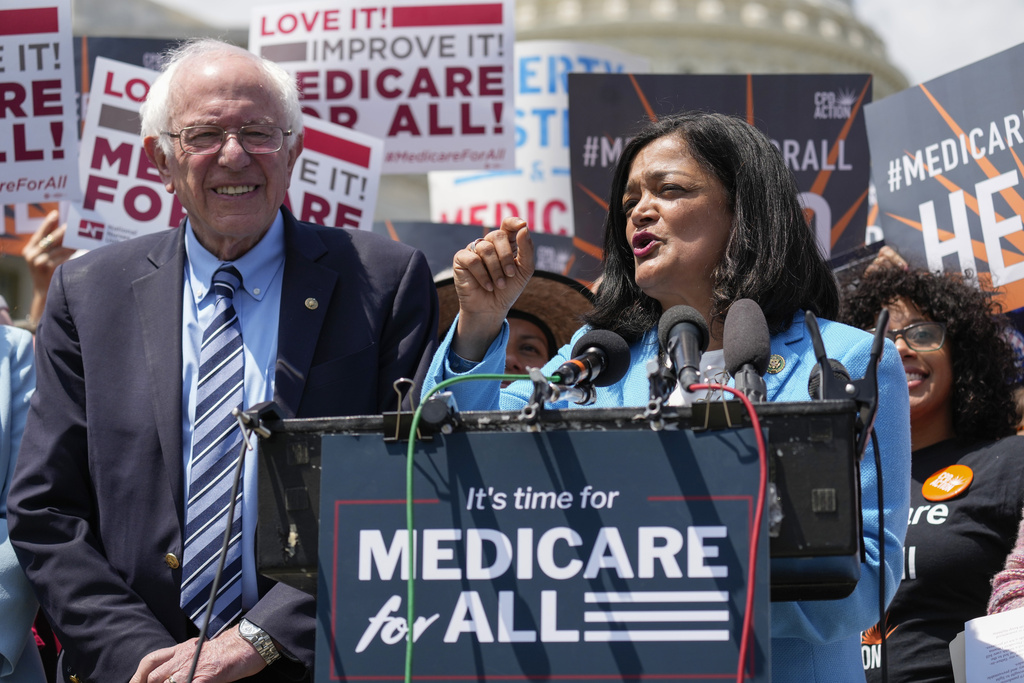
During a news conference on May 17, 2023, Rep. Pramila Jayapal, D-Wash., alongside Sen. Bernie Sanders, I-Vt., discussed their proposal for ‘Medicare for All.’ This initiative has been criticized as a misleading public policy strategy. The proposition uses Medicare’s popularity to promote a new government-run health care plan intended to replace the nation’s existing mix of insurance plans.
Currently, the U.S. relies on a combination of private and government-provided health insurances, including Medicare and Medicaid. Sanders aims to replace these with a single government-run system funded by taxes. Under this system, there would be no premiums, but all medical expenses would be government-paid. In similar models, like the one in the UK, the government controls the availability and timing of services and medications.
Sen. Sanders’s website claims ‘every resident of the U.S. will receive health insurance through an expanded Medicare program.’ However, critics argue this statement is misleading. Presently, Medicare includes multiple parts like Part A for hospital bills and Part B for doctor visits. Moreover, programs like Medicare Advantage, which 55 percent of seniors prefer, rely on private insurance. The new plan would eliminate such private sector options.
Comparisons with President Obama’s Affordable Care Act promises reveal potential dissatisfaction. While a large portion of Americans express satisfaction with current healthcare plans, ‘Medicare for All’ could disrupt existing coverage. A recent NBC News poll revealed high satisfaction rates among seniors with Medicare, with 42 percent being ‘very satisfied.’
Critics liken ‘Medicare for All’ to the UK’s National Health Service (NHS), where satisfaction levels are lower. In 2022, the British Social Attitudes survey reported only 26 percent satisfaction with the NHS. Frequent funding challenges and long waiting times affect Britain’s health services. The system often struggles to provide the latest treatments and drugs available in the U.S.
Medicare benefits from cross-subsidization by private insurance, where providers earn more from private payers. This makes it viable for them to continue serving Medicare patients. In contrast, a government-run healthcare system can succumb to political influence. This might result in limited access for the average citizen, while influential individuals retain priority access.
Merrill Matthews, Texas state chair of Our Republican Legacy, suggests that under ‘Medicare for All,’ government financial limitations could lead to reduced healthcare access for many Americans.