
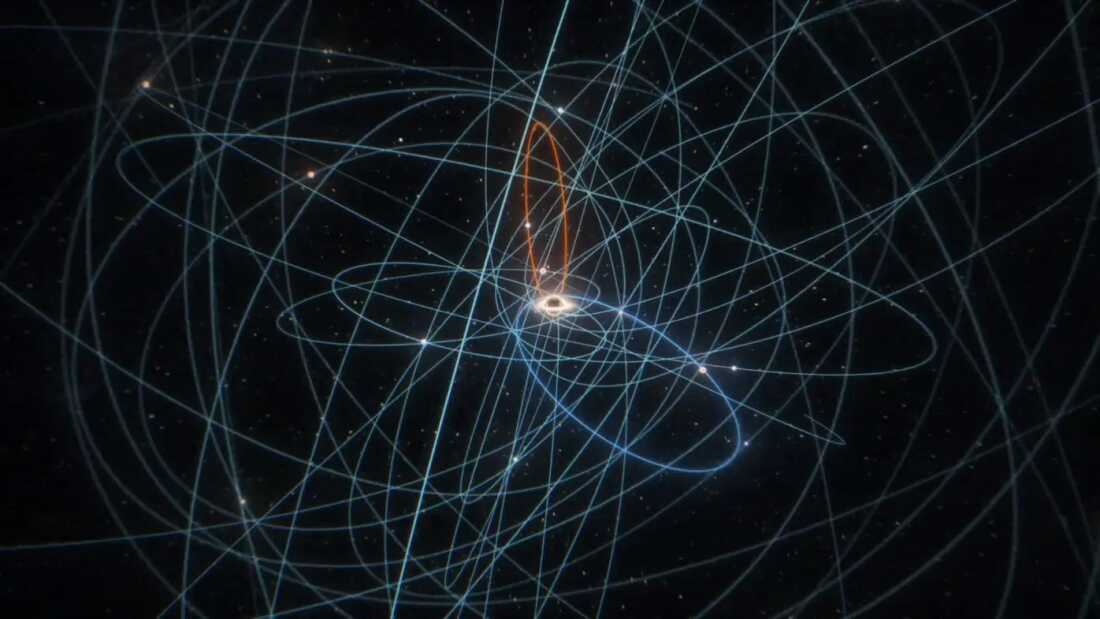
Scientists have mapped the paths of numerous stars orbiting the supermassive black hole at the center of the Milky Way galaxy. One star, S301, travels particularly close to the black hole, reaching speeds over 15,000 miles per second during its closest approach. This research, conducted by the Max Planck Institute for Extraterrestrial Physics, gives us insight into these celestial phenomena.
In 2002, researchers calculated the mass of the enormous black hole at the heart of our galaxy. It is estimated to be four million times the mass of the Sun, making it an almost certain supermassive black hole. Stefan Gillessen, an astronomer at the Max Planck Institute in Germany, suggests the black hole might resemble those depicted in science fiction, with a dark silhouette surrounded by a bright halo of light. While fiction often provides us with vivid images of black holes, observing them directly remains a challenge. Their gravitational pull is so intense that light cannot escape, making direct observation difficult.
Gillessen and his colleagues have found a promising tool to study black holes: a fast-moving star. Published in the journal Nature, their research highlights S301, the fastest observed star in the galaxy, orbiting Sagittarius A*, the Milky Way’s central black hole. The star’s speed is not as significant as its proximity to the black hole. This closeness allows astronomers to use the star to visualize gravity’s effects on space and time.
The Black Hole on Our Doorstep
Despite their vast influence, many questions about black holes remain unanswered. Gillessen notes the need to understand how black holes operate and impact their surroundings. The center of the Milky Way offers a unique opportunity to study these questions due to its proximity.
Gillessen’s team utilized four telescopes at the European Southern Observatory’s Very Large Telescope site in Chile. They employed infrared light to penetrate cosmic dust and gas, offering a view of the Milky Way’s nucleus. Felix Mang, a doctoral student at the Max Planck Institute, noticed a faint star moving rapidly in the data collected. This observation led to the discovery of S301’s unique orbit.
A Stellar Speed Demon
Tracking S301 over several years, Mang used Newton’s law of gravity with modifications from general relativity. His calculations showed an elongated elliptical orbit for the star, with the black hole at one end. The star accelerates as it approaches the black hole, reaching speeds of over 15,000 miles per second, nearly 8% of the speed of light. This makes S301 the fastest star observed in the galaxy. After its close pass, the star slows down as it moves away from the black hole.
This discovery allows scientists to better understand the black hole’s gravitational potential. As the star moves, it experiences the distortion of space and time caused by the black hole, helping visualize gravity’s effects.
Shedding Light on Black Hole Mysteries
Astrophysicist Erin Kara from MIT describes this as an ‘exciting result,’ paving the way for future black hole research. One goal is to determine the spin of the black hole in our galaxy’s center. Until now, such measurements have been made for actively growing black holes in other galaxies. Calculating the spin of Sagittarius A* could reveal insights into the Milky Way’s formation.
Kara notes the allure of black holes: they challenge our understanding of physics while being fundamental to explaining our galaxy’s structure. For Gillessen, imagining life on a planet orbiting S301 sparks wonder. Every nine years, this hypothetical observer would witness the black hole dominating the sky, an awe-inspiring spectacle offering a glimpse into the universe’s fabric.