
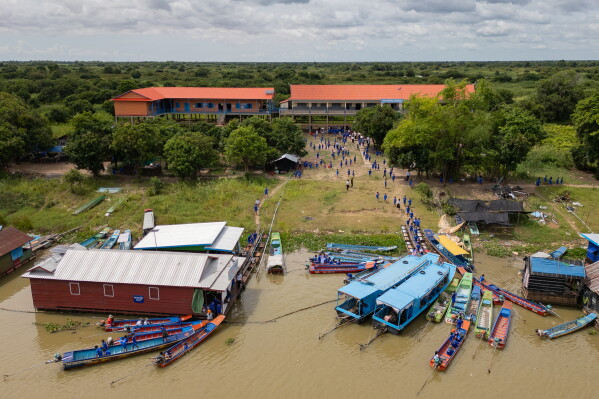
On the expansive Tonle Sap, Southeast Asia’s largest freshwater lake, daily life revolves around water. For schoolchildren in Kampong Prahok, this means taking gas-powered boats to reach school. Each morning, students, many as young as the passengers, navigate these waters. They visit floating homes to pick up peers dressed in crisp uniforms who step aboard carefully, protecting their backpacks from the water.
Recent geopolitical tensions, such as the Iran war, have raised fuel prices. This increase strains the budgets of students’ families, making school commutes more expensive. This factor complicates educational access for students arriving at a floating village school on Cambodia’s Tonle Sap Lake as observed on June 30, 2026.
The educational facilities in these villages incorporate diverse learning activities. Students engage in counting exercises and computer classes, as seen on June 29, 2026. Thirteen-year-old Sou Sreynich is one among those attending these classes, acquiring vital skills for the future. A glimpse of the classroom atmosphere highlights attentive students focusing on tasks ranging from computer lessons to reading picture books.
However, economic challenges persist. Some children are forced to leave school for work to support their families financially. This trend is exacerbated by cash-strapped governments in Asia struggling with funding educational initiatives and school meal programs crucial for keeping children in classrooms.
In Kampong Prahok, family life intertwines with daily survival tasks. Sou Sreynich collects firewood with her mother and sister, symbolizing the community’s reliance on local resources. School boats remain essential for students returning home, highlighting the constant interplay between education and livelihood in these floating villages.
This narrative of the Tonle Sap communities underscores the resilience and challenges faced by those living in unique circumstances driven by both natural and socio-economic forces. The Associated Press independently manages content in its climate and environmental coverage, supported financially by private foundations.