
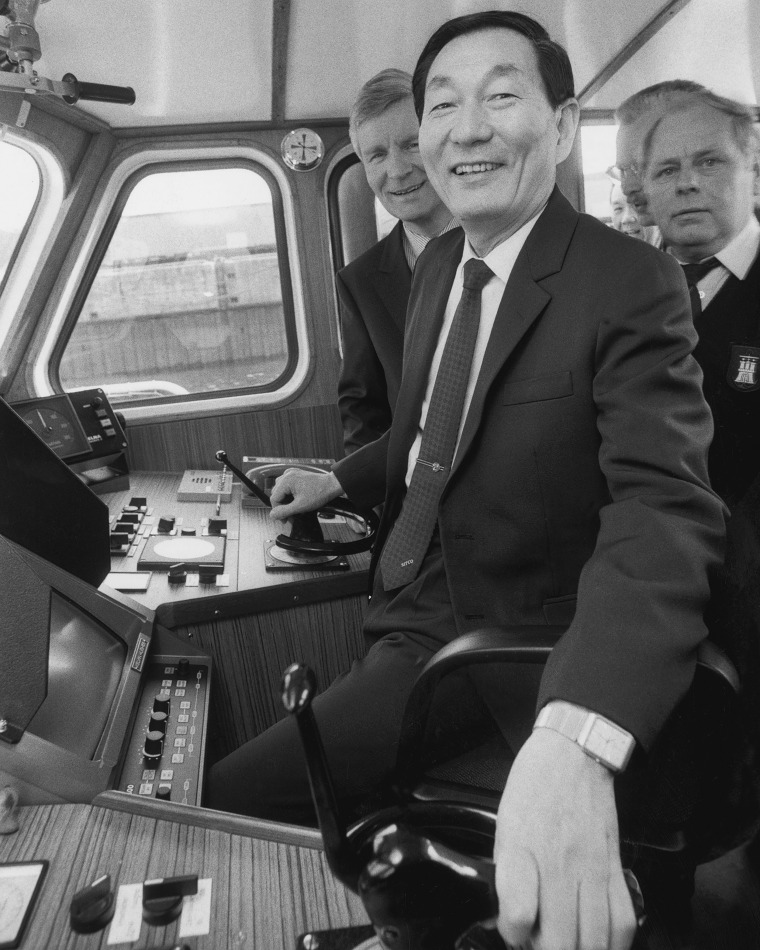
Former Chinese Premier Zhu Rongji passed away at the age of 97, reported state media. Known for his impatience and sharp tongue, Zhu was a reformer who played a pivotal role in igniting China’s rapid economic growth during the 1990s. His efforts included transformative changes in state industries and steering the country into the World Trade Organization (WTO).
The official news agency Xinhua announced Zhu’s death from illness in Beijing at around 11 a.m. on Wednesday. Zhu’s tenure as premier, from 1998 to 2003, marked significant reforms in China’s economic landscape.
Zhu clashed with Communist Party conservatives, as he pushed for state-owned enterprises to operate more efficiently. This meant massive layoffs, but it enabled China to surpass Japan as the second-largest economy in 2010.
Building upon Deng Xiaoping’s 1979 reforms, Zhu drove significant changes such as China’s WTO membership, positioning China as the world’s leading exporter. These efforts ensured consistent economic growth over 8% annually during the 2000-2010 period, peaking at 14.2% in 2007.
Appointed as premier in 1998 at 69, Zhu became popular for his direct criticisms of official missteps and for taking responsibility whenever the government faltered. His style earned nicknames like ‘Boss’ and ‘Madman Zhu.’
“I have prepared 100 coffins — 99 for corrupt officials and one for myself,” said Zhu in 1998, reported by People’s Daily.
Zhu occupied the third rank in the party hierarchy, behind President Jiang Zemin and National People’s Congress chairman Li Peng, yet lacked his own power base. He noted that this allowed some officials to disregard his commands.
In the 1990s, as deputy premier, Zhu tackled inflation through price controls and limiting loans to unprofitable state companies. He faced resistance from local leaders but persisted in reforms.
Zhu’s lead in securing WTO membership was crucial. Despite challenges, including a near-derailment during U.S. negotiations, Zhu maintained focus. China’s eventual WTO accession in December 2001 solidified free trade as a national priority.
An advocate of the state’s economic role, Zhu initiated the home ownership boom in 1998 by promoting the sale of state-owned apartments. This led to widespread private ownership in urban housing within a decade.
While Zhu reformed major industries into profit-driven corporations, he ensured government ownership remained. His strategy focused on efficiency rather than privatization.
Born on Oct. 23, 1928, in Hunan, Zhu faced exile during the Cultural Revolution due to his reformist views. His career rebounded post-Rehabilitation in 1979, swiftly rising through political ranks.
As Shanghai mayor in 1989, Zhu gained a reputation for moderation by defusing protests without military intervention. Zhu joined the Standing Committee in 1993, climbing party ranks under Jiang Zemin’s leadership.
Throughout his career, Zhu admitted and took responsibility for official shortcomings. His candid style often included humor, noticeably during press conferences.
Zhu’s significant contribution to China’s tax system, ensuring local revenue was redirected to Beijing, underscored his administrative acumen.
Rarely seen in public post-premiership, Zhu Rongji’s legacy endures through his decisive role in restructuring China’s economy.