
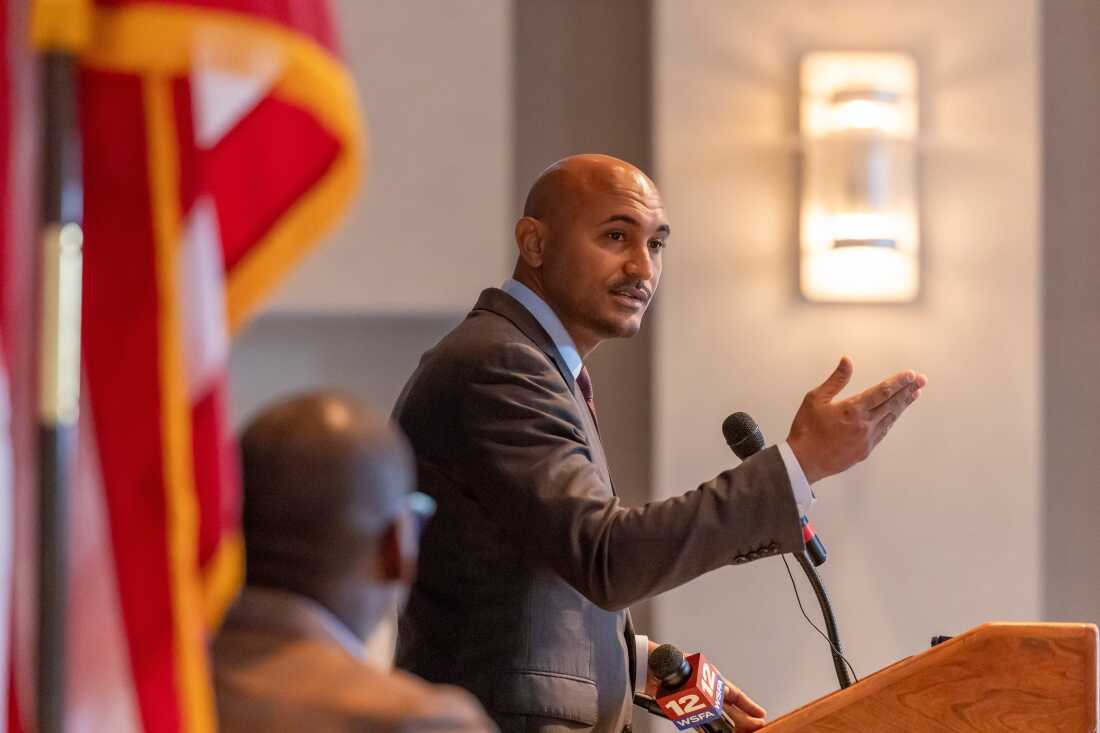
Rep. Shomari Figures addressed attendees at an event organized by the Montgomery Regional Chamber of Commerce on July 29 in Montgomery, Alabama. Nearby in Hope Hull, Willie Dixon and Mary Gatson gathered at Beulah Primitive Baptist Church, voicing concerns over recent alterations to Alabama’s voting districts. ‘Create enough chaos, and people will give up and go home,’ predicted Dixon.
Voters in parts of Alabama participate in their second primary amidst these changes. The U.S. Supreme Court nullified a crucial part of the 1965 Voting Rights Act, ruling against race-based districting. Subsequently, Alabama and several southern states rushed to redraw district lines before mid-term elections, potentially consolidating Republican influence.
As the elections approached, Alabama’s state legislature, predominantly Republican, reconfigured four of the state’s seven districts. This change affected a largely-Black district that had been reformed due to a prior court decision. Just before the May primary, these adjustments led to uncertainty and concern about voter turnout, particularly among Black voters.
Dixon noted, ‘With these two primaries coming close, people might not show up, thinking they’ve already voted.’
Lowndes County, part of Alabama’s Black Belt, is renowned for its rich soil and historical significance in the voting rights movement. The geographical changes might dilute and discourage Black voting power, raising concerns among local residents.
Democrats Strive for Representation
On July 30, Democratic Reps. Shomari Figures and Terri Sewell rallied at a community event. Sewell highlighted the significance of fair representation, criticizing the Supreme Court’s stance on acceptable partisan redistricting. Sewell emphasized that Black people account for over a quarter of Alabama’s population, yet face political marginalization.
Figures faces a challenging reelection campaign due to the redistricting; his district now excludes his hometown of Mobile. Despite this, he remains optimistic, aiming to showcase his record of representing all constituents.
Republican Opportunities
Meanwhile, the redrawn map has sparked Republican interest. Initially, Hampton Harris was the sole Republican contender for Alabama’s 2nd Congressional District. However, the new map attracted five additional candidates, creating a crowded race.
Harris expressed concern over the confusion voters might face due to rapid map changes. The August heat further complicates voter turnout during this special primary election cycle. Nevertheless, Republicans view this as an opportunity to flip a seat in their favor.
At a recent forum, candidate Joshua McKee welcomed the new maps, reflecting shared interests more accurately than the previous ones which included disparate areas like Mobile and Barbour County.
Jerry McGilvray, Barbour County Commission President, criticized prior redistricting efforts that connected geographically and culturally distinct areas. He believes rural interests align more naturally with the newly defined district.
The importance of voter participation is emphasized by local Republican efforts to energize their base amid potential voter apathy due to primary timing and format. Alabama’s open primary system allows strategic crossover voting, which has added another layer of complexity.
Rhett Marques, leading the Republican nomination race, received endorsements from President Trump, congressional leadership, and Alabama’s Republican Senators. As districts shift, Marques sees potential for gaining Republican control of Congress.