
Meteorologists have been closely monitoring Typhoon Dolphin’s approach to China. Alongside traditional forecasting systems, a new generation of artificial intelligence weather models is making its presence known. This highlights China‘s strong position in enhancing weather prediction capabilities.
Chinese-developed systems, such as Fengwu by Shanghai AI Laboratory, Pangu by Huawei, and Fuxi by Fudan University, are noteworthy. Researchers claim these AI forecasting models can generate forecasts far quicker than conventional systems. In some aspects, they match or even exceed traditional models in accuracy.
For many years, weather prediction relied on numerical models running on supercomputers, simulating atmospheric physics. AI models take a different approach. They learn from extensive archives of historical weather observations, producing forecasts much more rapidly. During East Asia’s typhoon season, this technology is being increasingly tested. Even slight improvements in track forecasts can aid authorities in better flood preparation, organized evacuations, and managing possible transport disruptions.
The rise of AI weather forecasting marks a new competitive field among tech companies, research institutes, and meteorological agencies, with China taking a leading role.
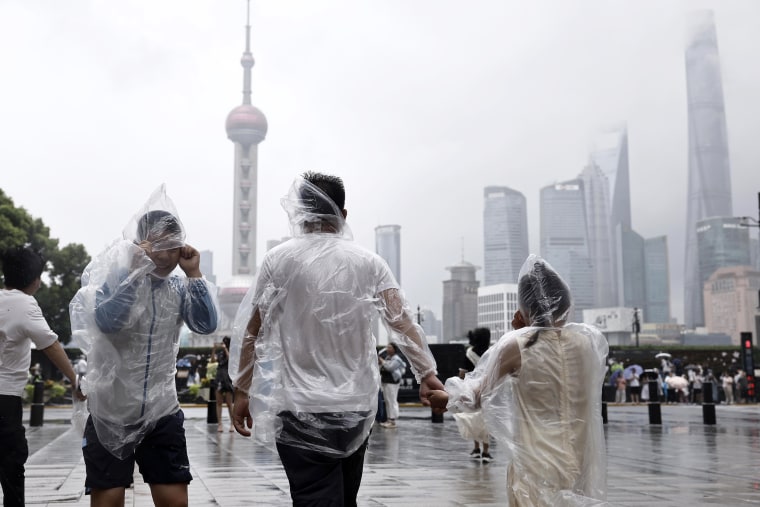
Tourists walk in the rain along the Bund on Sunday, in Shanghai. Yin Liqin / China News Service via Getty Images
Globally recognized AI forecasting systems include Google’s GraphCast and GenCast, Nvidia-backed FourCastNet, and the AI Forecasting System (AIFS) by the European Centre for Medium-Range Weather Forecasts.
Fengwu gained attention when developers reported it outperformed GraphCast across about 80% of assessed weather variables. It extended capable global medium-range forecasts beyond 10 days.
“With more extreme weather, people need information to make decisions, both local governments, the national government, also the average person, farmers and fisherman,” said Sun Zhi, the CTO of Techwind, the company handling Fengwu’s industrial uses. “So we want to help provide better information so people can make decisions.”
AI systems are becoming crucial complements to conventional forecasting due to their speed and reduced computing costs. However, they are unlikely to fully replace traditional models soon.
According to Techwind’s Sun, AI models are already capable of predicting typhoon paths. Five days before Typhoon Dolphin’s landfall, Fengwu predicted the time and place of impact on mainland China with precision, within 30 minutes and 30 km (19 miles). Yet, AI still lags in predicting storm intensity and remains untested in forecasting major climate developments.
“If we predict a climate change event 18 months in advance, people won’t believe it,” Sun said. “They need to know it’s reliable. We need to do years of scientific research before people trust us when we say there will be an El Nino event or we say the changing temperature on the sea’s surface will affect the breeding cycle of fish.”
As tech forecasters refine their systems, the combined use of AI and traditional methods is expected to continue for the foreseeable future.