
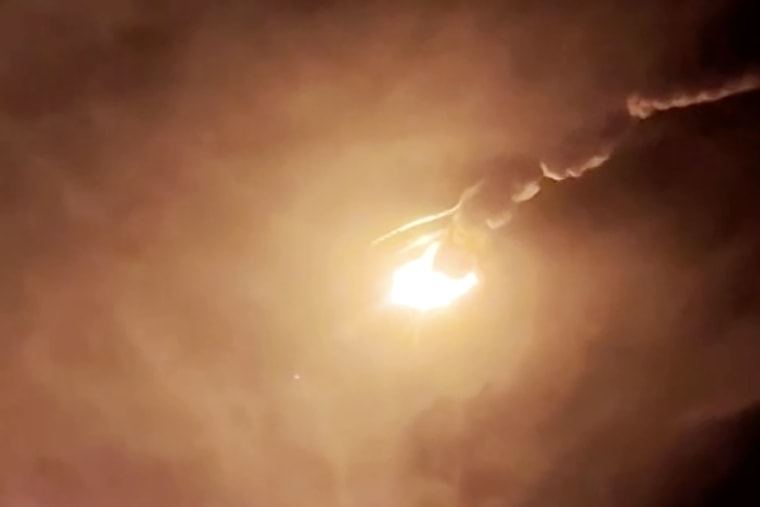
The Long March 7A rocket carrying the ChinaSat-4B satellite encountered an in-flight anomaly after its liftoff from Hainan’s Wenchang space launch site. The launch occurred at 8:02 p.m. Beijing time (8 a.m. ET) on Monday, but the mission failed according to Xinhua, China’s state-run news agency. Authorities are conducting an investigation to determine the cause.
Elon Musk, CEO of SpaceX, remarked on a social media post regarding the failed launch, stating that rockets are challenging endeavors. He expressed hope for a swift recovery.
Jonathan McDowell, an honorary professor at Durham University, analyzed the launch footage and noted that the rocket was destroyed at a low altitude, preventing the satellite or debris from reaching orbit.
This marks the first failure of the Long March 7A since its inaugural flight in March 2020, when a malfunction occurred during flight. Since then, the rocket had completed over twelve successful launches, according to records.
A report, later retracted from Baidu, identified the satellite as Zhongxing-4B, or ChinaSat-4B, and the launcher as a modified Long March 7, known as the Long March 7A. The ChinaSat-4B shares its series with ChinaSat-4A, launched in 2024, offering voice, data, radio, and TV broadcast services over wide areas.
The ongoing investigation will reveal if the failure is specific to the Long March 7A or if broader checks are needed for shared components, manufacturing, or launch-site operations.
Blaine Curcio of Orbital Gateway Consulting regarded the accident as a setback for the Long March 7A program, although he highlighted that the damage seems limited. The vehicle primarily deploys communications satellites to high orbit, so this failure is unlikely to affect the pace of launches to low Earth orbit.
China is gearing up for the Chang’e-7 lunar mission, set for launch at Wenchang with the Long March 5 rocket in the second half of 2026. Observers have suggested a possible launch window later this month. The Chang’e-7 aims to explore the Moon’s south pole, investigating shadowed craters potentially containing water ice.
The Long March 5 rocket differs from the Long March 7A, so Curcio expects no significant impact on the Chang’e-7 schedule.