
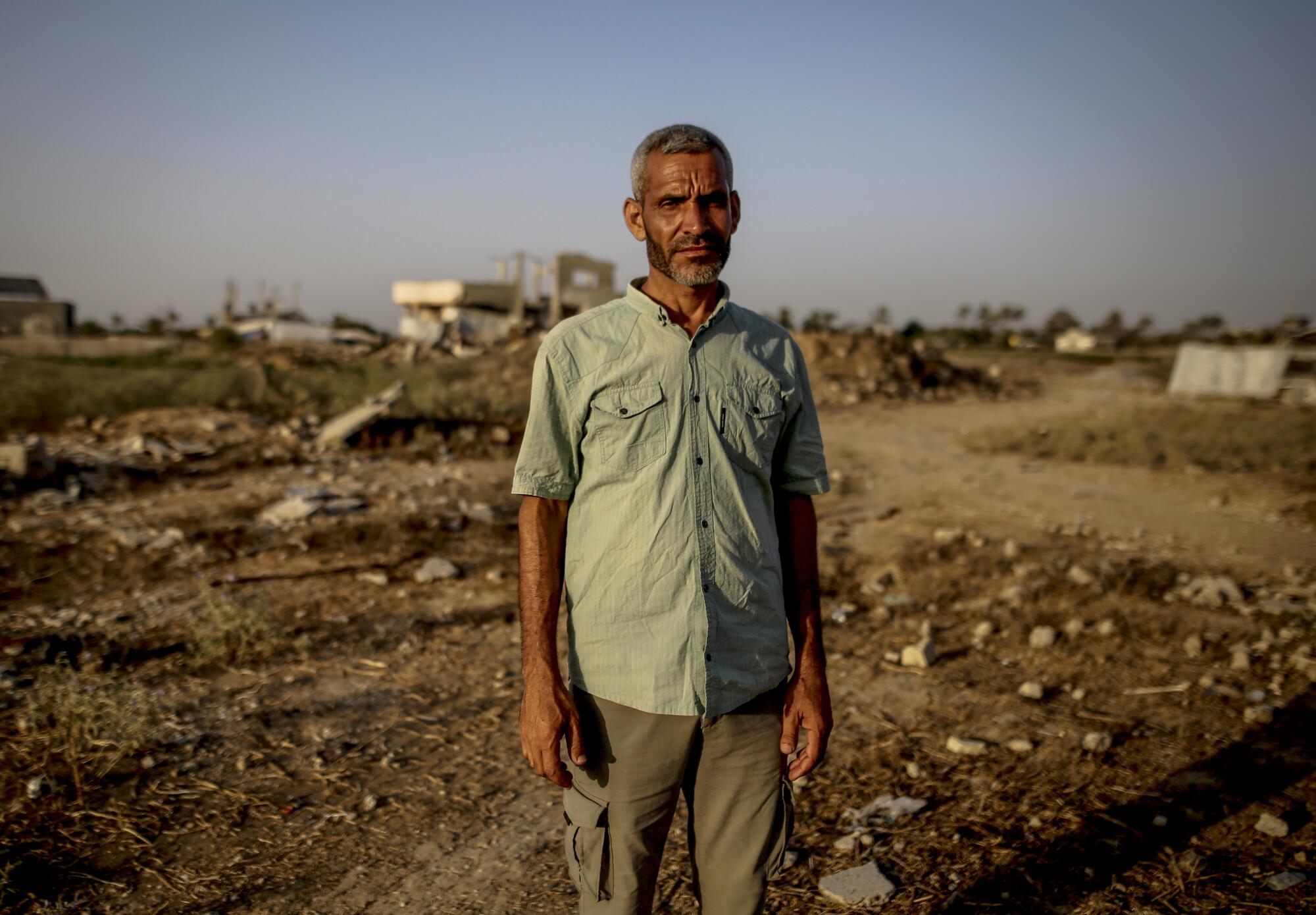
In the city of Deir al Balah, located in the Gaza Strip, Ashraf Al-Louh faces an impending decision. For three months, he watched the Yellow Line, the boundary of Israel’s military zone in Gaza, move inexorably closer to his shelter. Now, with the line just 100 yards away, Al-Louh realizes it is time to leave.
Many of his neighbors have already joined the exodus from this conflict-ridden area, marked by the large yellow-painted concrete blocks that signify the zone’s edge. These blocks have been placed and progressively moved westward by Israeli forces.
We’re exhausted. We’ve already been displaced seven times,Al-Louh, aged 45, shared, as he watched a donkey cart carrying elderly passengers and their remaining possessions trundle away from the Yellow Line.
The Yellow Line was introduced in October 2025, following a truce between Israel and Hamas. Although not recognized as an official border by international entities, this line effectively divides Gaza into a militarily controlled eastern section and a Palestinian-controlled western section. Despite the ceasefire, Israel has gradually shifted the line west, displacing thousands and confining them within an ever-decreasing space.
The Yellow Line is a quiet thief. It stole my land, my work, and everything I spent my life building,lamented Abu Miri, a resident affected by the creeping boundary.
Originally, Israel held 53% of Gaza. It now controls 64%, excluding a further restricted area called the Orange Zone. In this zone, aid groups must coordinate with Israeli forces to deliver supplies to the Palestinian area.
For Al-Louh and his family, consisting of his wife and six children, life under the Yellow Line’s looming threat has become precarious.
As he indicated, “About a month ago it was a kilometer away. Back then we felt there was still some safety.”
The Yellow Line’s advance is fraught with danger. Since the ceasefire began, 196 Palestinians, including women and children, have been killed near the line. Israel claims these incidents are defensive responses to perceived threats.
Defense Minister Israel Katz has emphasized that violating the Yellow Line will result in military action.
Nearby, Ahmed Al-Louh, Ashraf’s relative, hastily harvested vegetables from his field, aware that soon access might be blocked.
“I’m working all day to get it all out of the ground before we can’t reach here anymore,” Ahmed, 25, stated as he gathered unripe eggplants. He had already moved essential belongings to a safer location.
A recent announcement from Hamas indicated a willingness to disarm, conditional on Israel ceasing hostilities and agreeing to a withdrawal strategy. However, Israeli Prime Minister Benjamin Netanyahu insists on complete disarmament before any withdrawal.
Since October, Israeli actions have resulted in over 1,230 Palestinian deaths and vast destruction across the region. Satellite images indicate that Israel is fortifying the line with significant earthworks, suggesting a long-term military presence.
Netanyahu highlighted a strategy of incremental territorial acquisition.
For residents like Al-Louh, the approaching line follows a familiar pattern: the appearance of surveillance drones, followed by warnings and military action. Many, like Jamal Abu Miri, have watched their life’s work crumble under the advance. Abu Miri’s land investments were flattened by Israeli bulldozers, forcing him into displacement.
Everything I owned was supposed to support my sons and grandchildren. Now it’s beyond the line; it’s gone forever,he said.
The relentless push of the Yellow Line leaves Al-Louh awaiting an inevitable displacement. He has prepared for departure, knowing that the boundary now limits his world.
Special correspondent Shbeir provided reporting from Deir al Balah, and Times staff writer Bulos contributed from Beirut.