
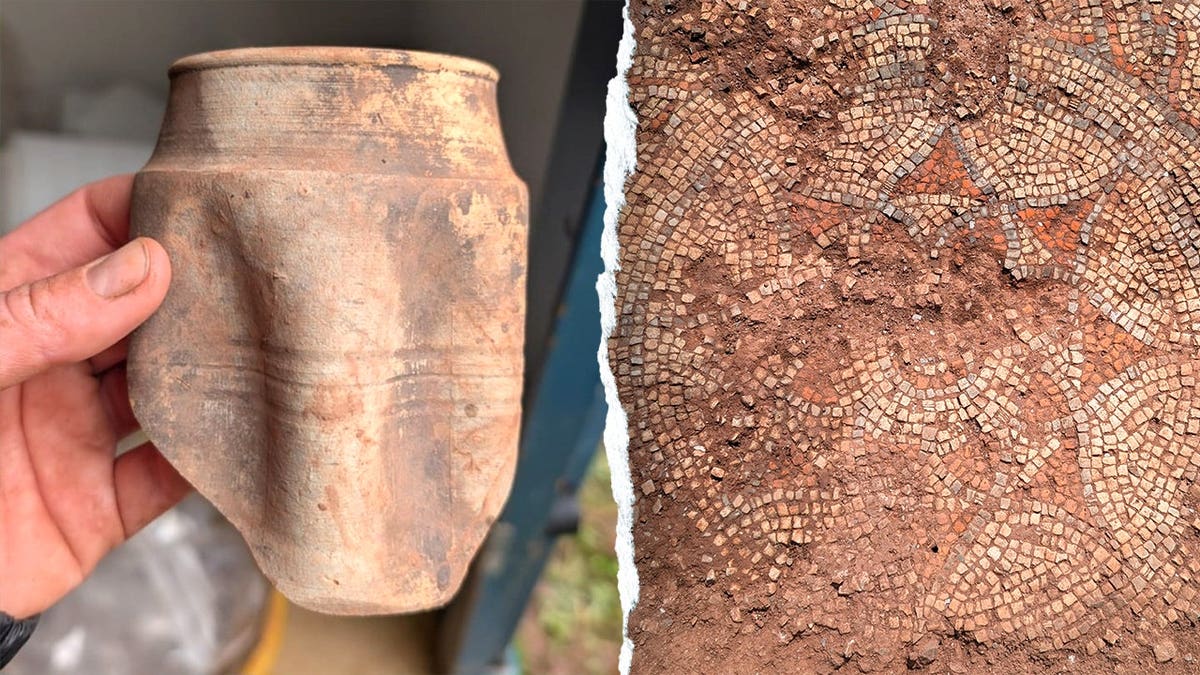
Archaeologists in the United Kingdom recently unearthed remains of an expansive Roman villa dating back over 1,600 years. The fourth-century villa emerged on farmland between Halberton and Sampford Peverell in Devon. This excavation is part of the Saving Halberton’s Ancient Roman Environment (SHARE) project, a collaboration between the University of Exeter and Cotswold Archaeology, as reported by SWNS.
The centerpiece of the find is an ornate mosaic, made of thousands of small stone cubes forming a floral pattern. Bill Horner, the county archaeologist for Devon County Council, remarked, “The polychrome mosaic is the most westerly example found in a Roman villa in Britain.” This discovery, along with other Roman artifacts, underscores the integration of even remote areas of Britain into the Roman Empire.
Images shared by officials showcase the mosaic and other discoveries like ancient pottery. Experts identified two additional stone structures alongside the villa—a bathhouse and another building likely used for agriculture.
“From day one, this site has given us a wealth of interesting and sometimes surprising findings,” said Susan Greaney, an archaeology professor at the University of Exeter.
Additional artifacts discovered include a copper-alloy bracelet, a silver-plated spoon, a drinking beaker, and various pottery fragments. A gemstone depicting the goddess Victory added to the wealth of finds. All this indicates the villa was once home to a wealthy Roman family. Britain was part of the Roman Empire from A.D. 43 to the early fifth century. The mosaic found here is the westernmost example ever discovered in a Roman villa in Britain.
The excavation site dates back to 2004 when local metal detectorist John Hill first identified Roman remains. There are plans to transport the mosaic to Tiverton Museum of Mid-Devon Life for further study and preservation.
This finding is among several remarkable Roman discoveries in England in recent years. An extensive Roman settlement was found in the Cotswolds last summer, and while preparing for a railway project, archaeologists unearthed rare Roman coins and artifacts.