
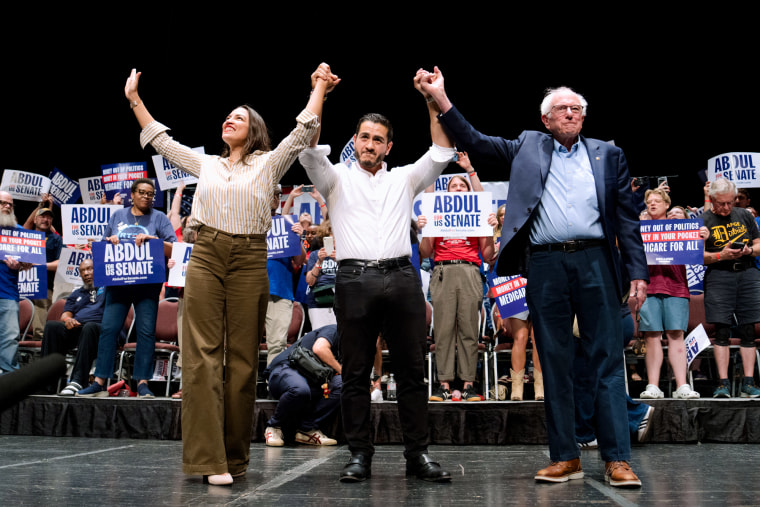
Abdul El-Sayed emerged victorious in Michigan’s Democratic Senate primary, according to projections by NBC News. He won a close race against Rep. Haley Stevens, securing a position for a progressive agenda in the Midwest during this midterm cycle. El-Sayed successfully countered a nearly $65 million influx of external funds. The support was primarily directed towards Stevens, who had the backing of the political establishment. Gov. Gretchen Whitmer, a prominent supporter of Stevens, endorsed her last month in a bid to halt El-Sayed’s momentum.
El-Sayed, a former public health official, will now compete against former Rep. Mike Rogers, who ran unopposed for the Republican nomination. The upcoming November election is expected to be highly competitive and may influence control of the Senate. The winner will replace Sen. Gary Peters, a Democrat opting not to seek a third term. Peters endorsed Stevens during the primary.
Republicans currently hold 53 seats in the chamber. Gaining four additional Democratic seats would mean a majority shift. However, Democrats need to defend seats in key states like Georgia and Michigan. President Donald Trump’s early support of Rogers helped secure the GOP primary. His wins in Michigan were in 2016 and 2024; he lost there in 2020 to Joe Biden. Rogers and other Republicans indicated El-Sayed could be a more advantageous opponent than Stevens. The National Republican Senatorial Committee created an online ad highlighting El-Sayed’s progressive credentials, including support from Sen. Bernie Sanders.
Sanders and Rep. Alexandria Ocasio-Cortez campaigned for El-Sayed, focusing on his “Medicare for All” stance, opposition to political money influence, and criticisms of Stevens who supported aid to Israel. His campaign aimed to test whether a populist movement gaining ground in states like New York and Colorado could succeed in a politically mixed region like the Midwest.
El-Sayed accused Israel of genocide against Palestinians in Gaza, a notable position in Michigan due to its significant Muslim and Arab American communities. He frequently criticized Stevens for accepting contributions from corporate PACs and the substantial TV ad support she received. These ads, presented by groups like the American Israel Public Affairs Committee (AIPAC), amounted to over $30 million.
Stevens, having spent significantly more on advertising, with her allies’ input, attempted to position herself firmly with the Democratic establishment. Aligning with figures like Whitmer, Peters, and Senate Minority Leader Chuck Schumer, she faced a strong challenge from El-Sayed, backed by national left-wing figures and the United Auto Workers, a major influencer in Michigan.
The primary’s final month saw increased hostility. State Sen. Mallory McMorrow, who attempted to bridge the gap between Stevens and El-Sayed, withdrew, endorsing El-Sayed shortly after. Her endorsement emphasized unity within the party as November approached.
Amid fierce competition, Stevens accused El-Sayed of neglecting Michigan’s local issues in favor of national politics. Whitmer’s endorsement stressed Stevens’ focus on state matters. An audio leak of an El-Sayed call suggested his win could inspire primary challenges in future elections, which some interpreted as a move to target figures like Stevens.
Stevens, while tackling social media commentary regarding her Midwestern accent, turned it into a campaign strength, connecting with Michigan residents. She addressed such criticisms at a debate, emphasizing her understanding of constituents’ needs.
El-Sayed remained consistent with his central message. He argued for politics driven by people rather than corporations and special interests, stating, “This is about whether or not you deserve a politics of the people, by the people and for the people.”