
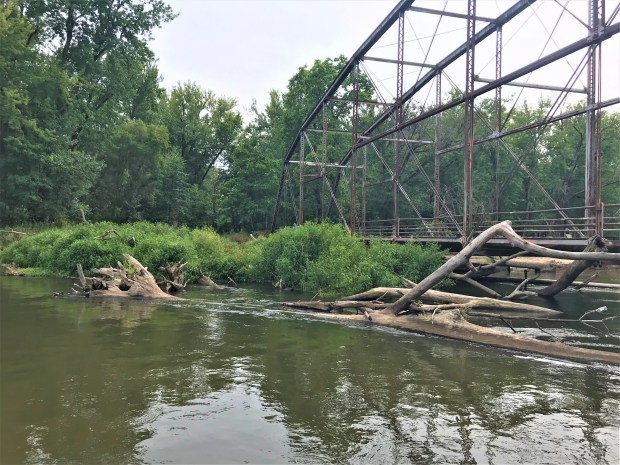
For many years, residents near the Kankakee River watched as logjams accumulated at the State Line Bridge. Now, the focus has shifted to removing the bridge itself rather than the debris that collects beneath it. The bridge, built in 1926 and decommissioned some time ago, is more accessible to debris than to people.
Located at the Indiana-Illinois state line, the State Line Bridge hangs low over the Kankakee River. This location causes it to collect large debris, increasing the risk of flooding. Its placement also complicates efforts to clear logjams. Scott Pelath, of the Kankakee River Basin and Yellow River Basin Development Commission, announced that the final federal permit for the bridge’s removal has been secured.
The removal project, costing $2.5 million, is set to begin this fall and conclude by December. The process involves using two cranes positioned on either side of the river to dismantle the bridge. Each piece will be labeled and stored for potential future reconstruction in a location where it won’t impede river navigation or floodwaters.
“The bridge has some historic qualities, and we will fully respect those,” Executive Director Scott Pelath stated. “This is not a salvage operation. We will take it apart piece by piece and safeguard the pieces for a community or organization that might want to reconstruct this piece of historic engineering.”
The Merrillville-based engineering firm Butler, Fairman and Seufert designed the removal plan, utilizing two cranes on a temporary river causeway. F.H. Paschen was selected in June to carry out the removal. Pelath confirmed that the commission has allocated the necessary budget for the project, emphasizing that bridge removal has been a priority since the commission’s establishment in 2019.
While the bridge is not the only one targeted by the commission, its unique location presents particular challenges. Pelath clarified, “The problem isn’t just that the bridge traps debris and blocks floodwater. The bigger dilemma is that because of the bridge’s location, it is impossible to remove the obstructions in the middle of a flood – right when you most need the water to move.”
Commission Chair John McNamara, a retired St. Joseph County surveyor, noted past efforts to remove the bridge. “I was chair of a previous Kankakee commission way back in the late 1970s, and we dreamed of removing the thing even then,” he recalled. “The bridge has been closed for almost thirty years, and it holds up high water every flood season.”
Newton County Commissioner and local farmer Rob Churchill shared similar sentiments. “Farmers like me have been worrying about this bridge as long as I can remember. The snow will melt, the rain will come, and we think about our drainage running into tons of steel. The bridge’s removal will be huge for farmers.”
Pelath acknowledged the support from the U.S. Army Corps of Engineers and Indiana officials in finalizing a preservation agreement that maintains the bridge’s historic value, while allowing the flood-control initiative to advance. This development marks an essential step in addressing the longstanding issue of flooding in the area.