
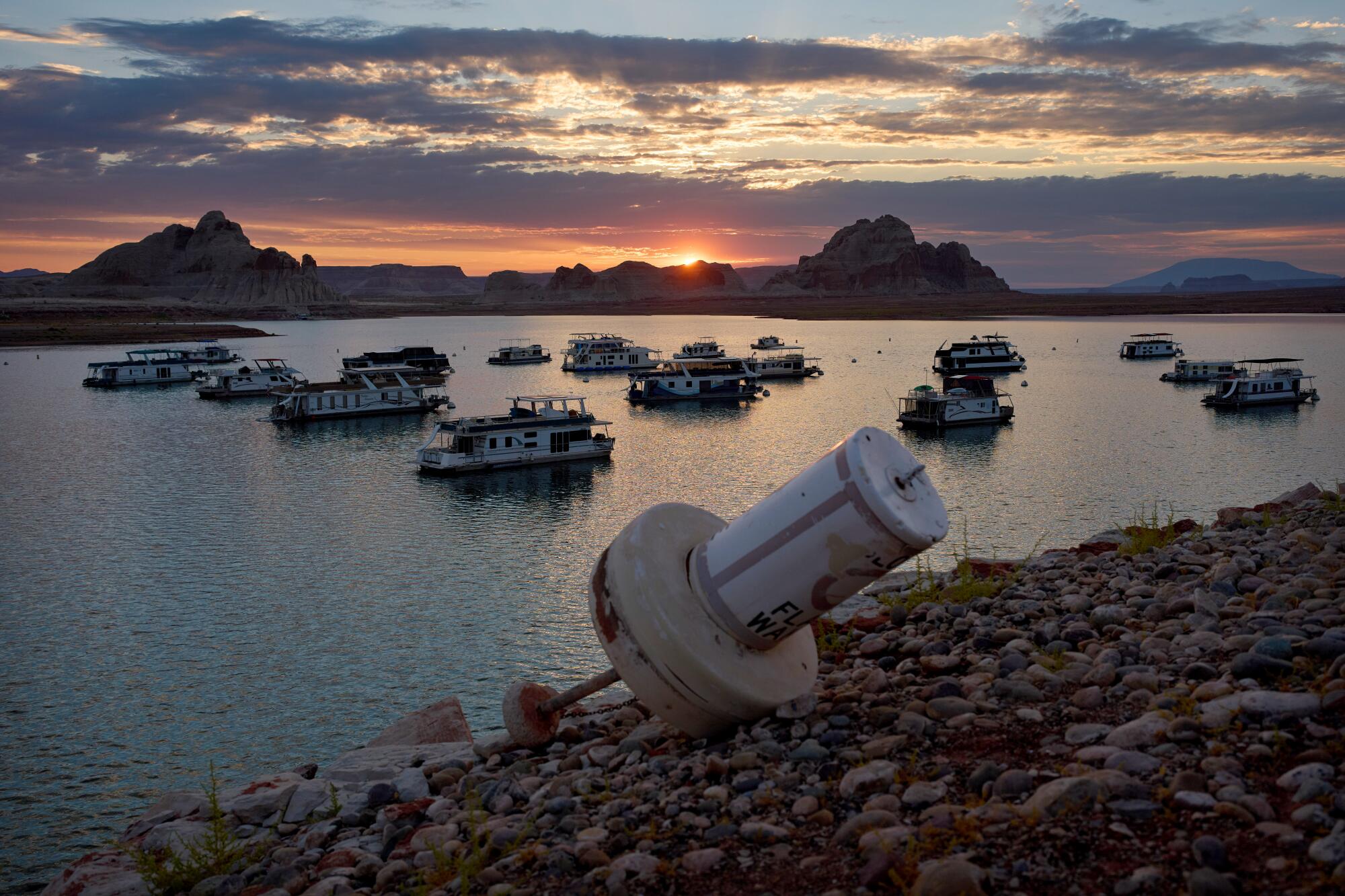
A buoy that once floated now sits above Lake Powell in Glen Canyon National Recreation Area near Page, Nevada. This illustrates the severe water issues the region faces.
The Trump administration has revealed its 10-year plan addressing the serious water shortages along the Colorado River. The approach involves potential significant reductions, possibly affecting California, Arizona, and Nevada by up to 3 million acre-feet per year, which represents as much as 40% of their combined allotments.
However, for the next two years, the administration has accepted these states’ offer to reduce water intake by approximately half—3.2 million acre-feet—by the end of 2028. This decision postpones the harsher cutbacks for now. The plan, announced on Friday, seeks common ground among the three downstream states and the upstream states of Colorado, Wyoming, Utah, and New Mexico.
Andrea Travnicek, the Interior Department’s assistant secretary for water and science, emphasized that the plan addresses “unprecedented hydrologic conditions.” The department’s announcement acknowledged that drought conditions over the last 25 years present significant challenges. Although the administration did not mention climate change, extensive research shows that global warming is exacerbating these dry conditions.
For the next two years, California is expected to decrease its Colorado River water use by about 12%, Arizona by 31%, and Nevada by 28%. The Interior Department describes the plan as adaptable to respond to the evolving conditions on the river through 2036.
The Colorado River, a vital water source for seven states and northern Mexico, has diminished significantly since 2000. Its main reservoirs, Lake Mead and Lake Powell, reached their lowest combined levels this year. New federal rules for addressing shortages are imperative as previous regulations expire.
Negotiations among the seven states have frequently stalled, while the river’s reservoirs continue dwindling. Scientific findings indicate that higher temperatures contribute to approximately half of the river’s flow decline. Each additional increase of 1.8 degrees in regional temperature may lead to an approximately 9% decrease in the river’s average flow.