
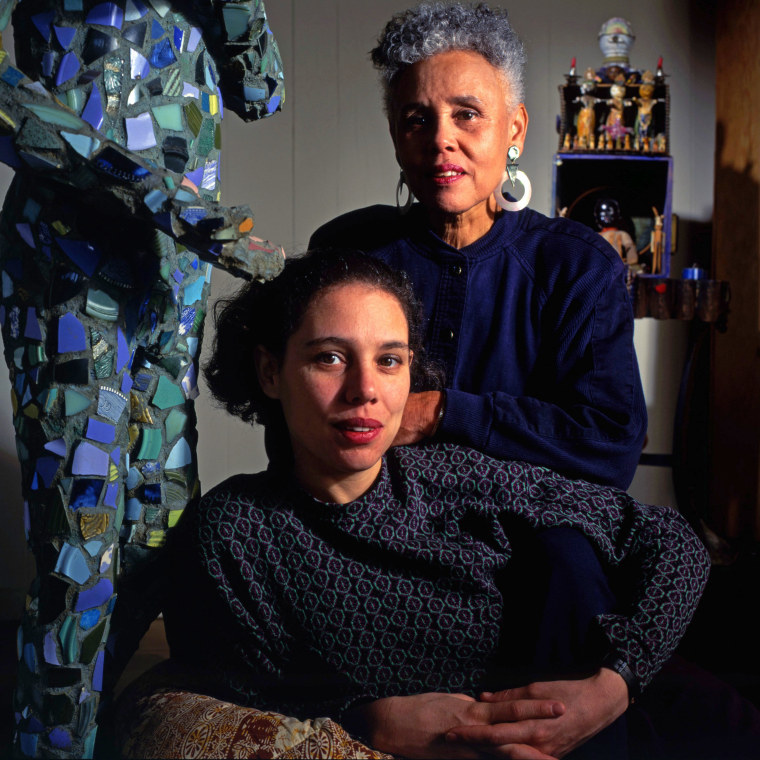
Betye Saar, an artist whose work deeply explored Black identity, culture, and spirituality, passed away on Sunday morning in Los Angeles at the age of 99. Her relatives confirmed her death on Monday. Saar, a significant figure in the 1960s Black Art Movement, was renowned for her assemblage boxes, which are sculptures crafted from found objects. She transformed Jim Crow-era memorabilia into powerful symbols of Black liberation.
According to Roberts Projects, the Los Angeles gallery representing her, her symbolically rich body of work has evolved over time to demonstrate the environmental, cultural, political, racial, technological, economic, and historical context in which it exists.
Early Life and Artistic Journey
Saar started her career in design and transitioned to art at age 35. She continued creating art into her 90s. Growing up in Pasadena, she was part of a community of Black artists in Altadena. Saar often cited Simon Rodia’s Watts Towers as an early influence on her work.
Her art practice included painting, printmaking, sculpture, and the use of found objects such as dolls, washboards, and antiques. Elements like boats, clocks, cages, and altars frequently appeared in her work alongside symbols of the occult and cosmology. Her astrological sign, Leo, influenced many of her pieces, often represented by lions.
Impact and Influence
Her appropriation of Black collectibles and everyday objects was transformative and subversive, redefined through her art, as noted by the gallery representing her. Among older Black American artists, she held a respected and unique position. Her work from 1969, “Black Girl’s Window,” was groundbreaking but only gained widespread recognition years later. The Museum of Modern Art acquired it in 2019.
One of her most significant works, “The Liberation of Aunt Jemima” from 1972, involved memorabilia that depicted negative stereotypes of Black people. In Saar’s reimagining, the figure smiles while holding a rifle and a hand grenade, transforming her into a revolutionary image. This response emerged following Martin Luther King Jr.’s assassination in 1968, which evoked a powerful reaction from Saar.
“I had a lot of hesitation about using powerful, negative images such as these — thinking about how white people saw Black people, and how that influenced the ways in which Black people saw each other,” Saar stated. “What saved it was that I made Aunt Jemima into a revolutionary figure.”
In 2020, Quaker Oat announced the retirement of its Aunt Jemima brand, acknowledging its racial stereotype basis.
Legacy and Recognition
Saar was a mentor to generations of Black artists, including the painter Kerry James Marshall. Despite exhibiting at the Whitney Museum of American Art in 1975, her work was sporadically shown at major institutions until 2019, when simultaneous solo exhibits were held at the Los Angeles County Museum of Art and MoMA.
In spring 2026, Saar was inducted into the American Academy of Arts and Letters. In 2025, she attended the LACMA Art+Film Gala in Los Angeles.
Angela Robinson Witherspoon, who produced a 2023 documentary titled “Betye Saar: Ready to Be A Warrior,” remarked, she had boundless energy for making art. I think she had a lot to say and was tired of the art world being dominated by white males.
The documentary featured interviews with John Legend, Tina Knowles, and others.
Saar’s ongoing exhibitions include “Let’s Get It On: The Wearable Art of Betye Saar” at Roberts Projects in Los Angeles and a collection of over 100 dolls on view at the New-York Historical Society in Manhattan.