
The narrative of Chicago’s Austin community is often dominated by statistics. Homicide numbers, crime maps, and poverty rates usually headline discussions, painting a grim picture of violence and hardship. While these issues exist, there is a different side to Austin. It is a community of neighbors who know each other, vacant lots turned into gardens, and youth linked to mentors. This is the Austin that Rev. Dollie Sherman has been nurturing for decades, one block at a time.
For almost 50 years, Sherman has made Chicago’s West Side her home. Her journey began with summer cookouts, school supply drives, and local initiatives to unite neighbors on the 600 block of Lorel Avenue. This effort evolved into the Vessels Unto Honor block club, a grassroots body focused on beautification, youth engagement, and resident support for over a decade.
“The block club has helped turn our block into a community,” Sherman said. “We’re not just waiting for somebody else to come along; we’re building it ourselves.”
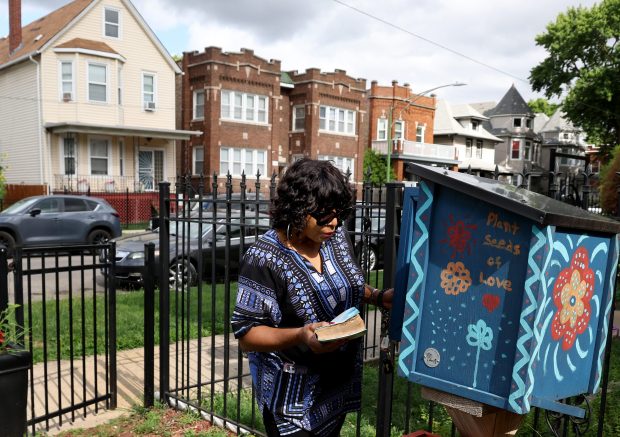
Sherman’s leadership mirrors a growing trend in Chicago. Residents and neighborhood organizations are stepping in to tackle challenges that government has not addressed. Linda Williams exemplifies this by organizing books in a free library box on North Lorel Avenue.
This community spirit was evident during the past Memorial Day weekend. Dozens of residents assembled on Lorel Avenue for the Center for Poverty Solutions’ first community job fair. Almost a dozen employers participated, providing interviews, collecting résumés, and connecting residents to job opportunities they might have missed.
Sherman proudly noted that the block is now recognized for its safety, cleanliness, and community spirit. This showcases how block club leadership can alter not just physical spaces but neighborhood cultures as well.
The job fair’s impact was swift: Over a dozen attendees received job offers, and 50 more secured interviews for full-time positions. More crucially, the event reinforced a message often missing in discussions about poverty and safety: People thrive when they have chances to contribute, sustain themselves, and dream about their future. This is why work matters.
“If we get our youth busy with something, I think it helps us avoid a lot of crime and vandalism,” Sherman said. “It also helps those youth.”
Employment offers more than just income. It instills stability, purpose, and dignity. In Chicago, over 97% of full-time employed individuals live above the poverty line, and 80% of part-time workers do too. For those unemployed, that figure drops to 68%. Jobs enable parents to support their families, empower young people to imagine a future, and reinforce community bonds, making neighborhoods safer and more prosperous.
Sherman has invested years in aiding young people facing homelessness and other challenges find a way forward through work.
“A lot of these youth are homeless. They’re staying with a friend, sleeping on their couch,” Sherman said. “But they’ll come here, and they’ll go back with something in their pocket after work. They can feel good about themselves.”
While no single job fair can resolve years of poverty or end violence, each resident linked to a job signifies a step toward independence. Every young person who opts for work over crime marks a significant step toward safety. Leaders like Sherman, who engage and invest in their neighbors, lay the groundwork for safer communities.
Sherman grasped this long before the Center for Poverty Solutions came to Lorel Avenue. It is a lesson for policymakers, philanthropists, and community leaders: Reducing poverty and increasing public safety are interconnected missions. Building pathways to employment fosters more than economic progress; it rekindles hope. That hope, cultivated block by block, is a formidable force for neighborhood transformation.
Eddie Kornegay, Ph.D., serves as executive director of the Center for Poverty Solutions, an initiative founded by the Illinois Policy Institute.