
Senator Lindsey Graham passed away on July 11th at the age of 71. The preliminary cause was an aortic dissection, which is a tear in the aorta’s wall. This artery is crucial as it carries blood from the heart. While the final death certificate is pending, this event is often termed “sudden.” Aortic disease typically remains unnoticed until a rupture or tear occurs.
Complications of the Aorta
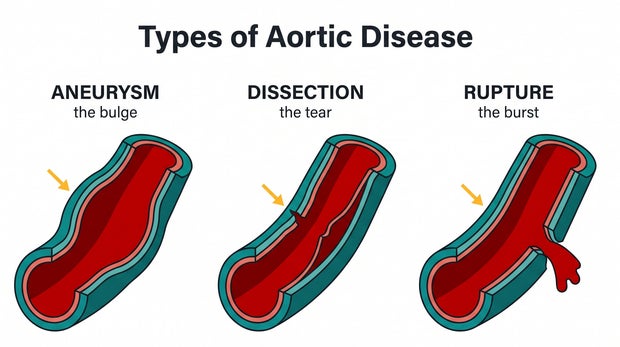
The aorta, the largest artery in the body, spans from the heart through the chest and abdomen. Three main issues can occur with the aorta: aneurysms, dissections, and ruptures. Although related, they are different and often confused.
An aneurysm refers to a bulge in the aortic wall due to a weak spot. It develops slowly over years and usually remains symptom-free, often discovered incidentally during unrelated scans. The risk increases as the aneurysm grows, weakening the wall.
A dissection involves a tear where blood infiltrates through the wall, creating a false channel. It is abrupt and an emergency, often presenting as severe chest or back pain. Dissections do not always arise from aneurysms; they can occur in an otherwise normal aorta.
A rupture is a complete burst, allowing blood to escape into the chest or heart sac. It often happens swiftly, potentially fatal in minutes and can result from either an aneurysm or dissection.
Bulge, tear, burst. Each condition can lead to another but differs fundamentally.
Dissections are more common in older adults due to high blood pressure and arteriosclerosis. Younger individuals with aneurysms likely inherit connective tissue weaknesses.
Personal Accounts
My husband, Grant Wahl, a soccer journalist, passed away in December 2022 at age 49 while covering a World Cup event. His death was due to an aortic aneurysm that ruptured. The aneurysm was located above his heart and measured 6.0 cm. Post-autopsy findings highlighted a thinned wall and internal structural breakdown.
Reasons for an Autopsy
As a physician and epidemiologist, I sought answers beyond “sudden death.” I requested an autopsy from the New York City medical examiner. My goal was understanding — had signs been missed, or could his death inform prevention for family members? The conclusive report provided clarity and dismissed misinformation linking the COVID-19 vaccine to his death.
Genetic Insights
The New York City medical examiner’s molecular genetics lab found a variant in the FBN1 gene, which is related to Marfan syndrome. Though Grant did not have the syndrome, a gene change pointed to a connective tissue issue. Such variants are known risks for aortic aneurysms in younger individuals.
Turning Loss into Prevention
This discovery prompted testing among Grant’s relatives. His brother, Eric, carries the same genetic variant. Ongoing imaging ensures early detection if changes occur. The same aortic issue that claimed actor John Ritter’s life is still often misdiagnosed, emphasizing the need for awareness and genetic testing where applicable.
Should You Be Screened?
- If you have a first-degree relative with a thoracic aortic aneurysm or a history of sudden death before 60, get screened.
- Consider screening if you show features of connective tissue disorders, such as unusual height or specific physical traits.
- Men aged 65 to 75 with a history of smoking should seek one-time abdominal ultrasound screening.
Genetic testing is advisable for those meeting specific criteria, including early-onset aortic disease or connective tissue disorder indications.
Known aneurysms allow management through blood pressure control and regular imaging, with surgical intervention at defined size thresholds.
If aortic conditions run in your family, discuss imaging and genetic options with your doctor.