
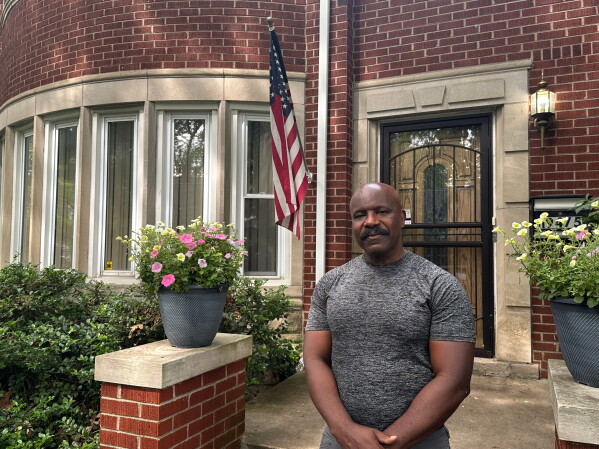
DETROIT (AP) — Jerry Esters displays the American flag outside his Detroit home. In contrast, Yvonne Pistochini refuses to let it shadow her residence. Both are Black, yet their views diverge significantly.
For Esters, the flag symbolizes the opportunities that allowed his family to prosper. He is the great-great-grandson of slaves, and he values his achievements in America. However, Pistochini, at 79, doesn’t recognize the America she grew up in through the flag.
A survey by The Associated Press-NORC Center for Public Affairs Research highlights how diverse Americans perceive the flag, factoring in politics, age, and race. Esters, aged 64, flies multiple flags at his home, as a tribute to the struggles faced and achievements gained over generations. He believes it represents the fight for opportunities.
The survey reached 2,596 adults from April 16-20, investigating attitudes towards the flag’s significance. Older Republicans and white Americans often see it as unifying, whereas younger Democrats and Black individuals do not.
This division in perception echoes other societal rifts in viewing America’s history and achievements.
About half of U.S. adults display the flag in their homes regularly or during holidays. 7 in 10 Republicans and around 60% of Americans aged 60 and older show flag pride at least during holidays. In contrast, 60% of Democrats and independents never fly the flag, including 75% of Democrats under 45.
Esters celebrates the flag as a representation of progress. His great-great-grandmother Moriah Martin, born into slavery, exemplifies fighting for success. He feels his life fulfills her dreams of owning a business and a home. However, only 3 in 10 Black adults share his sentiments, compared to about half of white and Hispanic adults.
Yvonne Pistochini calls the current polarizing views and inequality a misrepresentation of what the flag should embody. In her view, patriotism isn’t defined by flag-waving alone.
“Flying a flag doesn’t make you a patriot,” Pistochini says. She believes genuine patriotism is not evident due to ongoing societal challenges.
Ben Gaskins from Lewis & Clark College points out that the flag holds significance for older, white, and conservative Americans. Nancy Hansen, a retired Customs and Border Protection clerk, insists the flag represents freedom—to choose living, traveling, and raising kids.
In Culvertson, Montana, where Hansen resides, flags are posted by the American Legion, expressing patriotism. Similarly, Linda and Greg Cunningham from Pontiac, Michigan equate the flag with freedom, removing politics from their display.
Linda Cunningham states, “It’s our freedom. I love the American flag.”
Despite her passion, politics inevitably intertwine with the flag’s symbolism, prompting sadness.
The survey reveals 47% of participants find the flag unifying, while 16% see it as divisive. The remaining 36% perceive it as neither. Only 22% of Black adults view it as unifying, contrasting with 55% of white adults and 42% of Hispanic adults.
Allison Wiltz sees it as a painful reminder of unmet promises for people of color.
Paul Walthour from Minneapolis occasionally flies the flag on special occasions. He feels proud of what the flag’s supposed to represent, though he acknowledges its divisive role in current political discourse.
Williams and Sanders, Washington reporters, along with Parwani, contribute to this racial and ethnic dialogue.
The Associated Press-NORC poll reflects a representative sample with a margin of error of +/- 2.6 percentage points.