
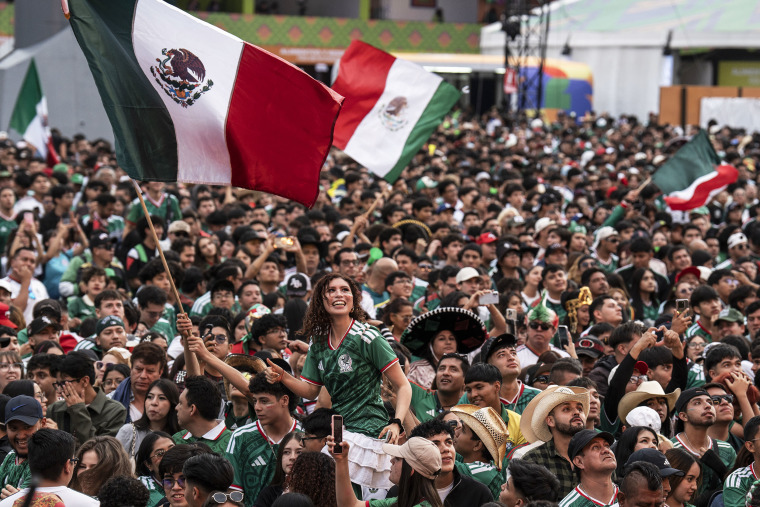
Javier Aguirre attributes Mexico’s World Cup success to their unity, describing the team as a family. This close-knit group achieved a historic milestone by winning all three group stage matches, ending with a commanding 3-0 victory over the Czech Republic on Wednesday.
Mateo Chávez, only 22 years old and in his first World Cup, scored in the 55th minute. Just six minutes later, Julián Quiñones secured his second goal of the tournament. Alvaro Fidalgo added another goal in stoppage time.
“It was something very beautiful, and I’ll take it with me to the grave,” said Chávez reflecting on his goal.
Historically, Mexico’s best group-stage performance was two wins and one draw, achieved in 1986 and 2002, both involving Aguirre. In 1986, he participated as a midfielder, and in 2002, he coached the team. Returning as coach for a third time, Aguirre is leading the team to new heights.
As the top team in Group A, Mexico is set to play at Estadio Azteca once more on Tuesday for a round-of-32 match, awaiting the announcement of their opponent.
“Now comes the knockout stage; statistics and data don’t matter. We’re achieving things, but what lies ahead is what counts,” Aguirre stated.
Mexico remains undefeated in nine World Cup matches held at Azteca, with 80,824 fans present for the game against the Czech Republic. The only two World Cup losses at this venue occurred during qualifiers, the last in 2013 against Honduras.
Wednesday’s match highlighted Mexico’s past and future. Seventeen-year-old Gilberto Mora became the youngest Mexican player to start in a World Cup. Conversely, 40-year-old goalkeeper Guillermo “Memo” Ochoa entered the game in the 77th minute, marking his sixth World Cup, sharing this distinction with Lionel Messi and Cristiano Ronaldo.
Following the game, Mora expressed, “It’s like a dream come true after everything I’ve worked for.” Despite acknowledging tough opponents ahead, he remains optimistic about Mexico’s chances.
Unfortunately, Mexico’s victory was overshadowed by a homophobic chant from fans aimed at Czech goalkeeper Matej Kovar, an issue that’s drawn sanctions in the past.
The Czech Republic, finishing with only one point, was eliminated from the tournament. Meanwhile, Mexico maintains an 11-game undefeated streak. Aguirre’s effective roster management saw 25 out of 26 players participate in the tournament, with Chávez one of five Wednesday starters who didn’t start the prior match against South Korea.
“Twenty-five of the 26 have played — that is no small detail — nor is it a small detail that everyone celebrates the goals,” Aguirre noted.
Ochoa, likely making his final appearance for Mexico, plans to retire after this World Cup. He expressed gratitude for his career, noting, “Life — football — had this farewell in store for me, to cap it all off perfectly. For my part, I’ve left it all out there; I gave everything.”
His journey included being a substitute in 2006 and 2010, and starting in the following three tournaments. Raúl Rangel is this year’s starting goalkeeper, replacing the injured Luis Ángel Malagón, who led Mexico to victories in the CONCACAF Nations League and Gold Cup. Malagón’s injury paved the way for Ochoa’s return, now the oldest Mexican World Cup player at 40, surpassing Cuauhtémoc Blanco’s record set in 2014.
After the match, Ochoa shared a moment of reflection and was embraced by his squad, acknowledging his possible farewell.
“Regarding Memo’s appearance, we don’t know if he’s going to say goodbye or not, but it was a nice tribute for his six World Cups,” Aguirre added.
Ochoa, a cherished figure in Mexican soccer, remains a symbol of dedication and skill.