
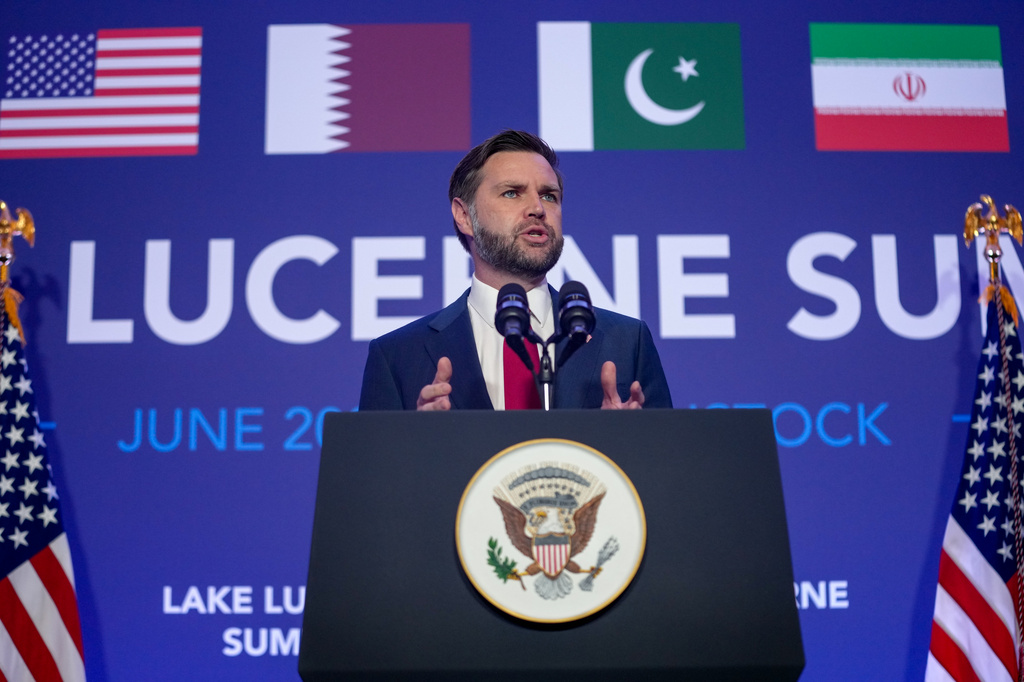
The Vice President JD Vance addressed the media after high-level discussions between the U.S. and Iran at the Bürgenstock Resort in Switzerland. Washington and Tehran signed the Islamabad memorandum which focuses on releasing $24 billion in frozen Iranian reserves upon a finalized agreement. President Trump has stated that the assets will be released only once a deal is achieved. This raises debates on whether and when to release the funds. There’s also the question of ownership and rightful use of these assets.
An estimated $100 billion in Iranian assets are frozen globally. These funds stem from the nation’s oil, commerce, and labor, and do not belong to a ruling elite. International law recognizes the Islamic Republic as a sovereign state, yet the regime, known for domestic repression and regional instability, is viewed as misusing national assets. Releasing these funds as if they reward aggression is seen as a misallocation, supporting the narrative that the regime’s interests align with its people’s, a notion Washington has begun to reject.
The U.S. has previously diverted funds from rogue regimes to benefit their populations. For instance, when Afghanistan’s government fell in 2021, the U.S. froze about $7 billion in reserves. The country set up the Fund for the Afghan People, a Swiss-registered trust, which safeguarded $3.5 billion from Taliban control while keeping creditors at bay. Similarly, a mechanism in place for Venezuela ring-fenced over $3 billion, keeping it out of the Maduro regime’s reach.
If these frozen Iranian assets are intended for its people, policymakers must determine the best use. Digital connectivity is crucial. Iran’s regime seeks to maintain control by restricting information flow, such as cutting off the internet during domestic uprisings. It has outlawed services like Starlink, penalizing users severely. Authorities even classify unauthorized connectivity as espionage punishable by death.
Despite these measures, Starlink’s presence grows, yet cost and accessibility pose challenges. Direct-to-cell service could circumvent these issues by connecting regular phones to satellites without additional hardware. The Pentagon has explored this for Iran, but the hefty $500 million launch cost and $100 million monthly operation stalled progress. A dedicated trust could bridge this funding gap.
The U.S. has previously prioritized internet access for Iranians as a key policy tool. The Office of Foreign Assets Control has specific authorizations like General License D-2, supporting communication tools to counter state censorship. This regulatory framework allows the leasing of satellite capacity for the Iranian public.
To scale up, an Iranian People’s Connectivity or Internet Freedom Fund can be established. It would draw from frozen Iranian assets and operate independently, similar to funds for Afghanistan and Venezuela. It would ensure the regime’s lack of access, while legally supporting connectivity initiatives under U.S. regulation.
The U.S. administration faces a strategic choice: return the reserves and potentially fund oppression or allocate them to weaken regime control through connectivity. This path resonates with millions of Iranians opposing the regime, who remain rightful owners of the assets. Only this choice aligns with American interests, supporting those who seek change. A connected Iran undermines the regime’s grip, paving the way for a freer nation.