
On June 22, 2026, astronomers announced that the interstellar comet 3I/ATLAS could be significantly older than our solar system. This makes it a unique object in our cosmic neighborhood. Previous to its discovery, only two other interstellar visitors had been observed by humanity. The brightness of 3I/ATLAS provided scientists with an exceptional opportunity to study a celestial body from elsewhere in the galaxy.
The comet was first spotted in July of the previous year. Its discovery sparked online excitement and speculation, including a theory by a prominent Harvard researcher that it might be an alien spacecraft. However, NASA dismissed this theory.
Renowned telescopes have been gathering new data on 3I/ATLAS. A study published in Nature suggested that the comet might be up to 12 million years old. This is considerably older than our solar system, which formed around 4.5 billion years ago. NASA’s Martin Cordiner stated that it might be the oldest object seen in our solar system.
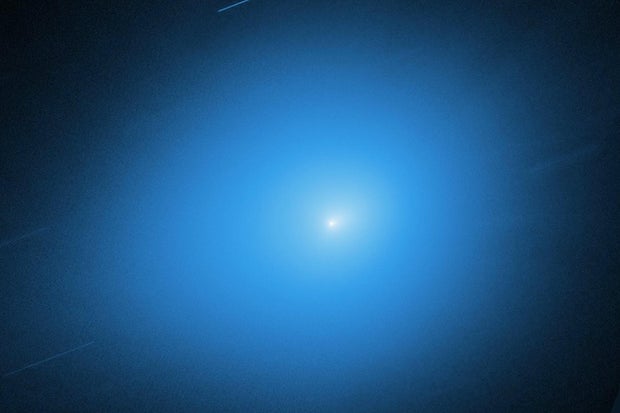
 This image, provided by NASA, shows the comet captured by the Hubble Space Telescope on November 30, 2025, while it was 178 million miles from Earth.
The new research relies on the comet’s isotopic composition, measured by the James Webb Space Telescope and the ALMA observatory in Chile. The study notes that the chemical composition of 3I/ATLAS differs from any known solar system body. The comet contains 10 times more deuterium, a form of hydrogen seen in heavy water.
The high levels of deuterium suggest that the comet formed in an environment that was extremely cold, reaching temperatures as low as minus 243 degrees Celsius. The exact origin of 3I/ATLAS within the Milky Way remains unknown. However, researchers believe it formed similarly to our solar system’s comets – ejected during the formation of new planets.
3I/ATLAS is likely not bound to any star, having traveled for billions of years along vast paths across our galaxy. Its lack of chemical enrichment suggests it formed close to newly born stars. Cordiner proposed that it might even be a ‘relic’ from an era known as ‘cosmic noon,’ a period when many stars formed approximately 10 billion years ago.
Previous interstellar objects, like 1I/’Oumuamua and 2I/Borisov, did not provide sufficient brightness for gathering isotopic data. NASA has released images of 3I/ATLAS, including one from November showing the comet about 180 million miles from Earth.
Last October, Mars orbiters captured images of the comet’s progress, showing it as a bright dot moving against distant stars when it was about 18,641,135 miles away from Mars. NASA and the European Space Agency provided an image of the comet from July 21, 2025, at 277 million miles from Earth.
Harvard professor Avi Loeb suggested that 3I/ATLAS could be more than a comet, opening up discussions on possible non-terrestrial origins. However, NASA and the Search for Extraterrestrial Intelligence Institute (SETI) have found no evidence to support alien technology on the comet.
Astronomers who studied 3I/ATLAS but weren’t involved in the new study praised the findings. Darryl Seligman from Michigan State University commented on how these measurements provide insights previously unattainable for interstellar objects. The comet’s age remains uncertain, though he noted it likely predates our solar system’s formation.
Peter Veres from the International Astronomical Union’s Minor Planet Center described the research as groundbreaking. With the comet now exiting our solar system, it will become increasingly difficult to observe. Still, scientists anticipate discovering more interstellar objects soon, particularly with the Vera C. Rubin Observatory in Chile.
Cordiner concluded that this marks the start of a new field, offering extensive learning opportunities about our galaxy.