
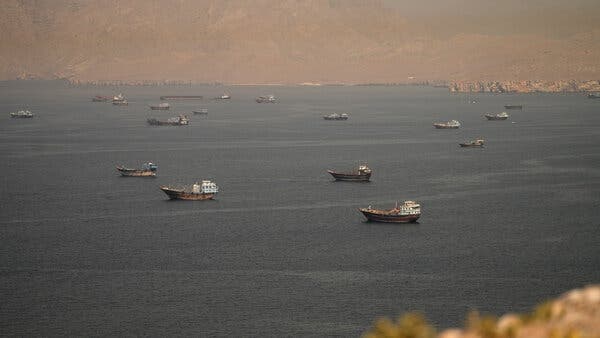
The Strait of Hormuz remains a critical point of negotiation between Iran and the United States. On Sunday, uncertainty prevailed as both nations issued contradictory statements about the status of the waterway.
There was a noticeable decline in ship traffic through the strait, according to maritime analysts who rely on limited data available. However, the exact reason for this drop remains unclear. This vital corridor, important for oil and gas shipping, has become a focal issue in discussions aimed at resolving the ongoing conflict between the two nations.
President Trump warned Iranian officials against closing the strait. ‘You close it and you won’t have a country,’ he stated, as Vice President JD Vance conducted talks with Iranian representatives in Switzerland.
On Saturday, Iran’s military announced the closure of the strait, citing U.S. violations of the recent cease-fire agreement. They accused the U.S. of not curbing Israeli military activities against Hezbollah in Lebanon. The Iranian Revolutionary Guards Corps also issued cautions to ships nearing the strait, highlighting security threats.
Nevertheless, U.S. Central Command disputed this claim, asserting the strait remains open. Capt. Tim Hawkins stated, ‘Iran does not control the Strait of Hormuz. Traffic continues to flow, and U.S. forces are monitoring the situation.’
Ship tracking data indicates a halt in attempts by vessels to traverse the northern route of the strait, following Iranian threats. Maritime intelligence firm Ambrey noted the tense situation, with no reported attacks despite Iran’s assertion that the strait is closed.
Windward, another maritime intelligence firm, reported a decrease in transits on Sunday, compared to previous figures. U.S. Central Command mentioned that 55 commercial ships managed to navigate the strait on Saturday, marking a peak since the war began, albeit lower than prewar averages.
U.S. Energy Secretary Chris Wright confirmed that 67 ships passed through within the last 24 hours, aided by U.S. military guidance via a secured shipping lane. Windward highlighted that several ships had disabled transponders to avoid detection, emphasizing the corridor’s unpredictable nature.
Leo Sands is a correspondent with The New York Times Breaking News Hub, based in London.